
- 1. 7 Volcanic Origin Destinations in Spain with a Special Energy
- 2. La Palma
- 3. Tenerife
- 4. Lanzarote
- 5. Girona
- 6. Ciudad Real
- 7. Almería
- 8. Castellón
7 Volcanic Origin Destinations in Spain with a Special Energy
The interest in Spain's volcanic heritage is greater than many people believe, and it is not limited solely to the Canary Islands. "In Spain, there are over a hundred volcanoes, although only a few are considered active because they have shown any signs of activity during the Holocene, in the last 10,000 years," emphasizes Manuel Regueiro, president of the Official College of Geologists (ICOG).
For those who want to take advantage of their summer vacations to discover this heritage, the College of Geologists proposes some destinations of volcanic interest without leaving the borders of Spain.
La Palma

This small island in the Canary archipelago features a natural park, a natural monument, and a national park dedicated to volcanoes. The most recent is the Cumbre Vieja Natural Park, where one can observe everything from prehistoric volcanic flows to the most recent ones. Guided walking tours are available, concluding near the volcanic cone, but at a safe distance.
Very close to Cumbre Vieja is the Teneguía Volcano Natural Monument, the epicenter of the last volcanic eruption on Spanish soil prior to that of Cumbre Vieja. This volcanic area features flows, lapilli fields-small lava fragments ejected during the eruption-and volcanic cones in a desert environment with very little vegetation. Several trails allow visitors to explore the natural monument's highlights, including the Teneguía and San Antonio volcanoes. However, the lack of vegetation means that sun protection and plenty of water are essential, and it is recommended to undertake the walks in the early hours of the day.
The third point of volcanic interest on the island of La Palma is the Taburiente Caldera National Park, a spectacular volcanic crater, eight kilometers in diameter and one and a half kilometers deep, covered by dense Canary pine forests. This national park is located in the center of the island and is its most visited tourist attraction. Walking tours through the interior of the park are available, and a visit to the Roque de los Muchachos, an impressive viewpoint at 2,426 meters, is highly recommended.
Tenerife

Without leaving the Canary Islands, we travel to Tenerife, where Teide is located. Situated in the center of the island, Teide National Park has an average elevation of 2,000 meters and is not only the most visited in Spain but in all of Europe. The area formed by the Teide and Pico Viejo volcanoes rises over 3,000 meters.
One can explore the park by car, and there is also a cable car that takes visitors to the upper station, at 3,555 meters above sea level. From there, a trail leads to the Teide crater. Various trails with tour guides allow visitors to enjoy the spectacular nature of the park.
Lanzarote
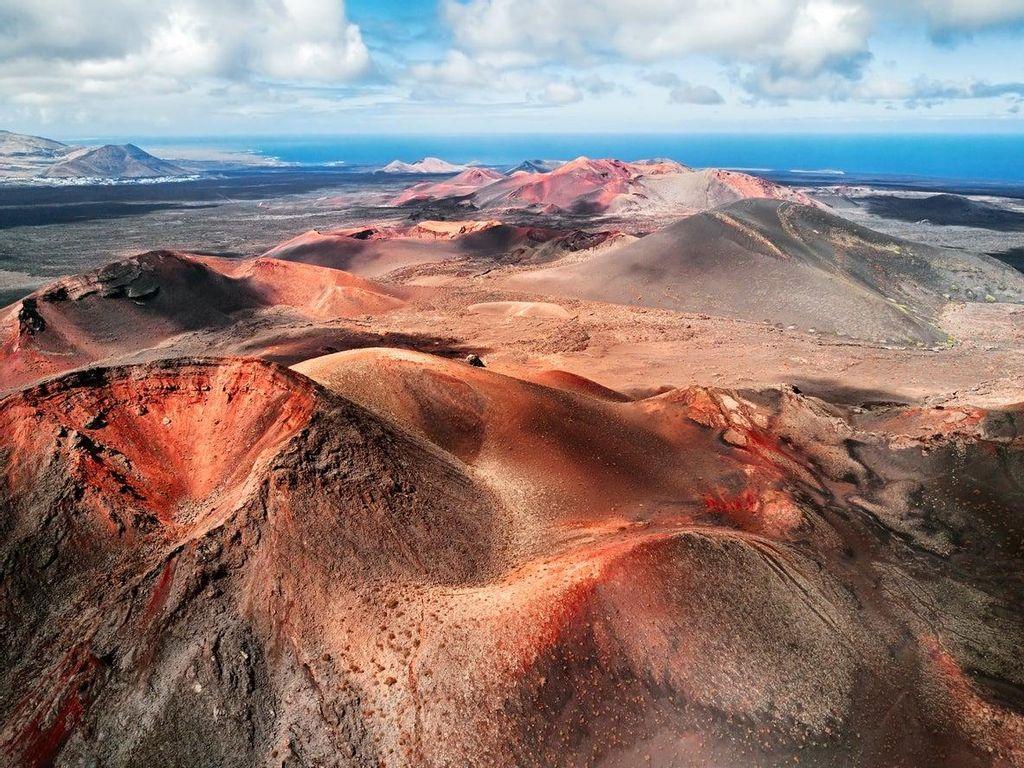
On the easternmost of the islands lies Timanfaya National Park. Once again, we find a volcanic site that recorded its last eruption in 1824. It has over 25 volcanoes, some as iconic as the Fire Mountains, Montaña Rajada, and the Corazoncillo Caldera.
It still presents volcanic activity, and in some areas, surface temperatures reach up to 100 degrees Celsius. Walking tours, car excursions, and even camel rides can be taken to discover a landscape characterized by a lack of vegetation and the ruggedness and variety of colors in the terrain.
Girona

La Garrotxa Natural Park is one of the active volcanic areas of the Iberian Peninsula, although as vulcanologist Joan Martí explains, "the probability of an eruption is very low given its long recurrence period, which ranges from 5,000 to 20,000 years."
It has around 40 volcanic cones, including the Santa Margarida Volcano, whose last eruption occurred 11,000 years ago, and the younger Croscat, which is of the strombolian type and the largest in the peninsula. In the city of Olot, the Montsacopa Volcano can be found, featuring a crater that is 120 meters in diameter. The natural park has several walking routes through the most interesting sites, including Croscat, Santa Margarida, and Montsacopa, as well as other volcanoes like Sant Marc, Puig Roig, Rocanegra, and the lava flows of Molí Fondo.
Ciudad Real
Another volcanically active area, though currently with very low risk, is the Calatrava Field. Its volcanic area occupies an expanse of 5,000 square meters that encompasses well-known localities such as Ciudad Real, Almagro, and Daimiel.
Within this area, there are about 300 volcanic manifestations ranging from the Morrón de Villamayor de Calatrava, which is 7.5 million years old, to Columba, located between Calzada and Granátula de Calatrava, which is about 5,000 years old. Between Granátula and Valenzuela de Calatrava lies the Cerro Gordo volcano, the first volcanic museum in the peninsula.
Almería

The mainland territory contains several volcanic areas considered inactive. One of them is located in the Cabo de Gata-Níjar Natural Park and includes a set of both underwater and surface volcanoes, such as Fraile Grande and Fraile Chico, as well as the calderas of Plomo and Majada Redonda.
"The volcanism is dated between 15 and 16 million years ago, when magmatic activity began in the Alborán Sea," explains Martí. These remnants of volcanic activity can be explored on foot through the various trails that wind through the Cabo de Gata-Níjar Natural Park.
Castellón
Finally, off the coast of Castellón is the Columbretes Islands Marine Reserve, an archipelago of small volcanic islets located 48 kilometers from the coast. The most important islets are Illa Grossa, Ferrera, Forada, and Carallot. The largest, Illa Grossa (Big Island in Valencian), is characterized by its semicircular shape, which corresponds to the emerged part of a volcano's crater. The Columbretes Islands can be visited by boat from Castellón, Oropesa, and Valencia, and diving is possible in its waters.
Overall, this volcanic heritage may have a different origin, according to experts. "More associated with a hotspot in the case of the Canary volcanoes, while on the peninsula it is related to periods of expansion and contraction of the Earth's crust that facilitate the melting of the upper mantle and the ascent of magma," concludes ICOG president Manuel Regueiro.