
If You Already Know About the Auroras Borealis, Wait Until You See the Auroras Australis
The phenomenon that is, for many, the greatest gift of nature and the most mysterious spectacle of the sky is often only associated with one part of the world. We are referring to those ethereal dances visible above the starry sky as if they were multicolored curtains. That is to say, the auroras that almost inevitably carry the surname "borealis."
However, many do not know that this kind of miracle of Arctic nights also occurs in other latitudes. That there are other corners of the planet where you can also witness this play of flashes of green, purple, or violet tones which, of course, has a scientific explanation: upon reaching Earth, the particles that make up the solar wind are deflected by the Earth's magnetic field towards the polar regions, where they collide with the upper layers of the atmosphere, emitting energy in the form of light.
Proximity to the Poles
The auroras borealis, also called "Northern Lights," occur from October to March, although the peak months, experts say, are typically January and February. To see them, you must travel very far north, specifically to that oval area surrounding the pole which more or less coincides with the polar circle. This is why the best locations are Alaska, Norway, Iceland, Greenland, Finland, and Canada.
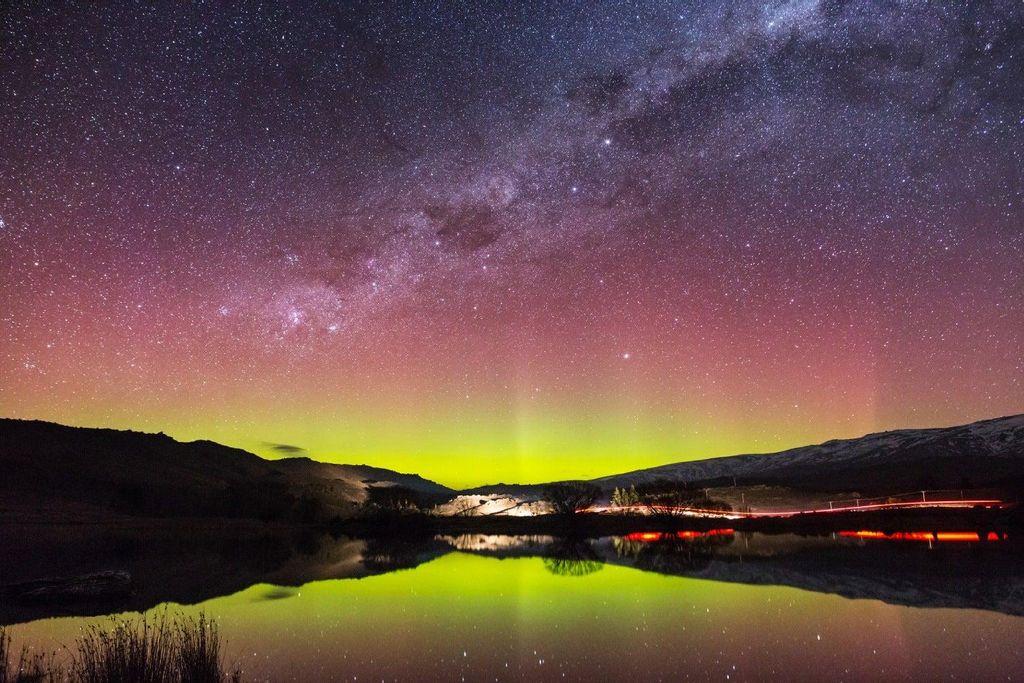
So far, everything is known. But, as we mentioned, there is another type of aurora: those that carry the name "australis." A phenomenon of lights sibling to the aurora borealis, known as "Southern Lights." And although it is the same phenomenon and beauty is its common trait, it does not take place in the same places nor in the same season of the year.
Dragons in the Sky

The auroras australis are those that occur near the South Pole, and like their northern counterparts, they were observed in the West hundreds of years ago, when they were considered snakes or dragons in the sky. It was not until the 17th century that scientists began to study them, and it was not until 1768 that Henry Cavendish managed to understand and explain the phenomenon.
While both are very similar in form, in the case of the aurora australis, it is common for them to appear as luminous points or in long arcs extending to the horizon, aligned with the Earth's magnetic field. As for colors, they can be red, orange, green, or yellow, or multiple colors can occur simultaneously.
Australia, New Zealand, Antarctica, the Falkland Islands, and various points in South America (especially in Argentina and Chile) are the best places to witness the auroras australis, among other corners of the Southern Hemisphere.
Also on Other Planets

And the moment, of course, is when it's the coldest, as the period of sunlight is shorter and nights tend to be longer, ideal conditions for the phenomenon to occur. That is to say, autumn and winter, two seasons that, in these parts, take place between March and September.
Like the borealis, the aurora australis can last from a few minutes to several hours. According to scientists, it is around midnight that they can be best observed, as at that moment the lights increase much in brightness and then, in the morning, begin to fade until disappearing.
The phenomenon of auroras (both borealis and australis) also occurs on other planets in the solar system that have similar behaviors to Earth. Some claim that on Jupiter, Saturn, Uranus, and Neptune, which have strong magnetic fields, they could also be seen.