
The Story of the Spaniard Who Circumnavigated the Globe by Car
"Of the twenty books I have written, The Shortest Way is the one that has brought me the most satisfaction." With this phrase, Manuel Leguineche opens the prologue of the sixth edition, long after completing his journey. It is a retrospective statement from a retrospective book, as throughout his life, both he and thousands of readers would look back on this particular feat as if Marco Polo wore thick black glasses and wrote chronicles of the Vietnam War.
"I don't know how to drive or anything about mechanics, but I can sing, play mus, have a great sense of humor, know a bit about geography, and I've read Conrad, Stevenson, and Verne."
That year in Madrid was cold and there was a strike at the Complutense University. At just over 20 years old, in the winter of 1964, the young journalist and failed law student met his friend, photographer Willy Metter, who spoke to him about the project and promised an interview with the American journalist who would lead the expedition. The location was a tavern in Madrid. The interview consisted of a series of questions in which, as a good aspiring journalist, he lied to all of them. This is how he got to embark on the project: to break the world record for distance driven in a car, beginning a journey prompted by boredom with his own life, where everything went right and wrong, where he fell ill, worked, lied, and sometimes helped others before himself.
The Shortest Way
Understanding why the book he wrote stemming from this journey, despite being unknown to many and rarely reedited, has impacted so many readers. The first clue may lie in the text he presents. It is a text by Hermann Hesse, in which he states: "The shortest way to find oneself is to go around the world. I intend, therefore, to travel the world." It serves both as a brutal beginning and a clarification of intentions. This was a personal journey, motivated by the author himself and with no other pretensions than to do something and tell about it. In summary, a journey that we can all relate to, in one way or another.

He traveled from Madrid to Jerez and then to Tangier, without even knowing how to change a spare tire. The goal was to break the record of 33,790 kilometers driven that Peter Townsend achieved in the late 50s. They exceeded it by over 5,000 km; however, throughout the journey, the goal of achieving this faded away until it nearly vanished among its more than 600 pages, prioritizing anecdotes and creating a historical snapshot of a world that today feels somewhat familiar.
During the nearly three years that the journey lasted, Leguineche traversed a world that barely registers with us today, where it was safe to travel from Jerusalem, the theme park of religions, to Tehran by car and the Southeast Asia was redefined with the onset of wars in Laos, Cambodia, and Vietnam. He shared the period and the scene with Mother Teresa of Kolkata, whom he interviewed, as well as the Dalai Lama and India's minister, Indira Gandhi. The Shah was, at that time, the ruler of Afghanistan, and in Egypt, Gamal Abdel Nasser ruled with an iron fist.
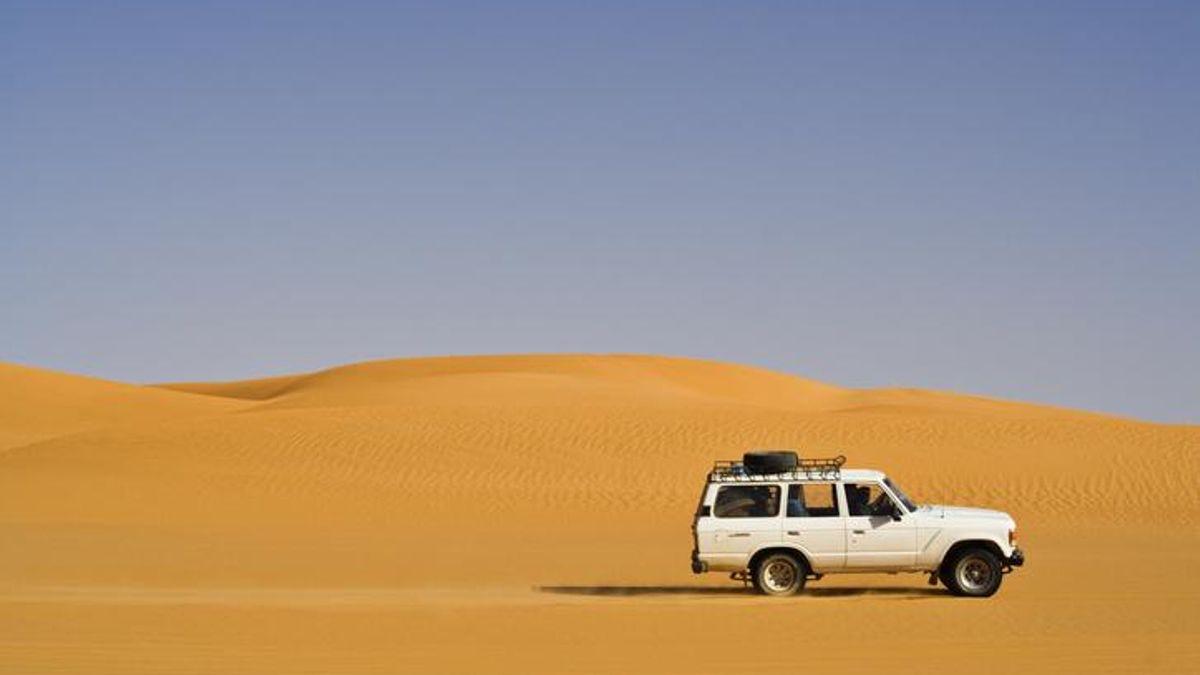
He played football with the King of Cambodia-scoring a goal completely disregarding protocol-crossed the Sahara with diphtheria and relied on support to survive, and hunted a tiger in India. During his time in Thailand, the expedition fell apart, forcing him to survive at the hands of a con artist in the vitamin pill business. With his focus on the present, all events are treated with partiality and from experience, without intending more than to capture the moment. This honesty and lack of pretense is possibly the reason for its popularity.