
Cuéllar: 5 Secrets to Fall in Love with Reconciliare
Among castles, walls, churches, chapels, convents, palaces, and fifteen thousand hectares of pine forests, Cuéllar rises, an authentic medieval town known as the Mudéjar Villa due to the twists of its history. In Cuéllar, Queen María de Molina summoned the Courts, and the town witnessed the marriage between Pedro I the Cruel and Juana de Castro. Here, fratricidal wars were fought, but Christians and Mudéjares, "the subjected ones," coexisted, leaving the finest representation of Mudéjar art, rich in decorative arches and minarets, contrasting with the sobriety of the Romanesque architecture of that time. Today, Cuéllar hosts Reconciliare, a unique treasure in the world, which with nearly one hundred works narrates the story of humanity's reconciliation, from Adam and Eve to the present day, through sacred art.
Reconciliare: San Andrés
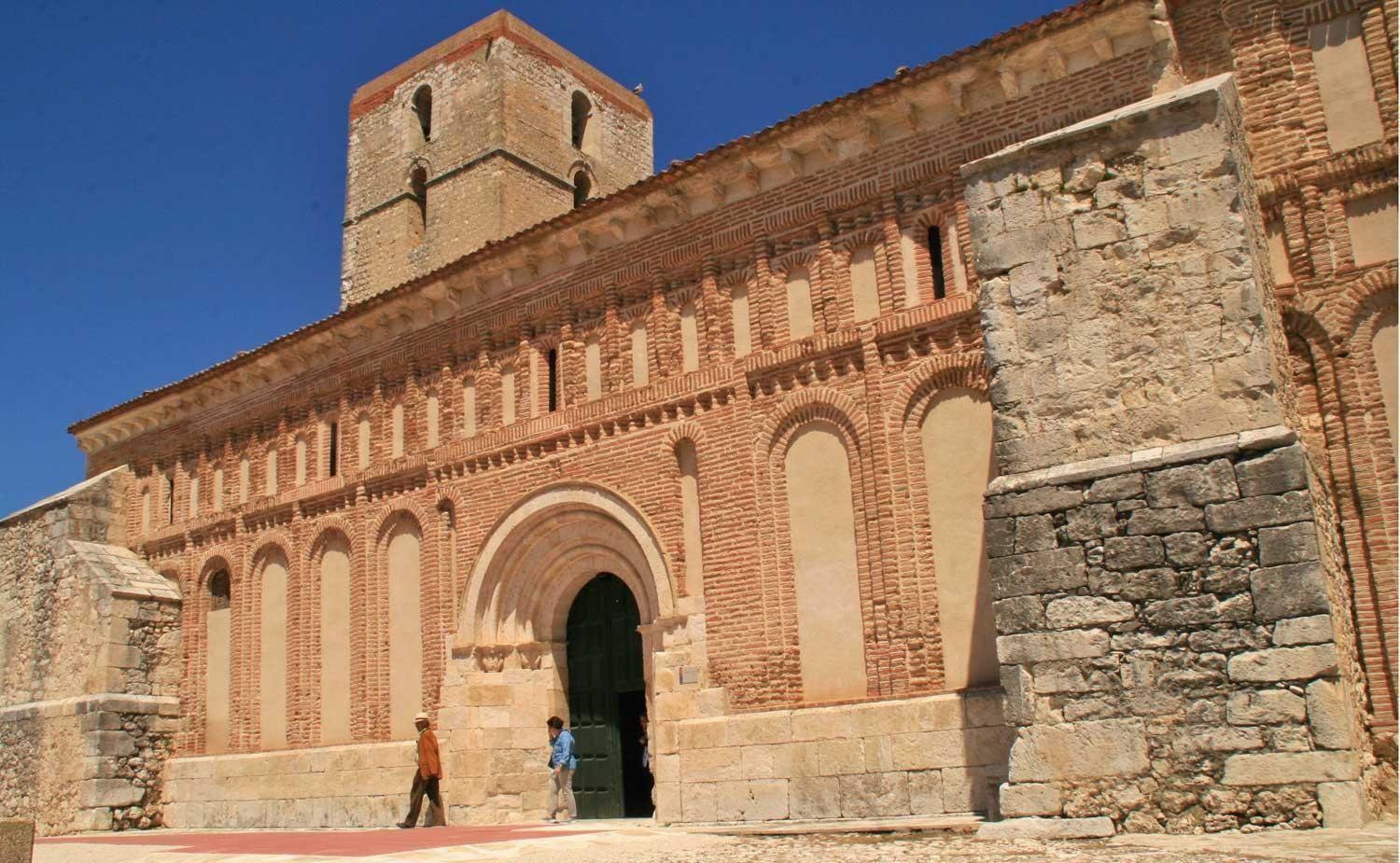
Visiting Cuéllar coinciding with Las Edades del Hombre is a delight. The itinerary for Reconciliare begins at the 13th-century Church of San Andrés, the only temple outside the town's walls, located in what was the suburb of the town during medieval times. It stands out for its exterior brick decoration. In its three outer facades and three apses, it overflows with Mudéjar richness, and in its southern and western facades, it maintains Romanesque stone. Its interior showcases magnificent Mudéjar polychrome paintings. San Andrés is the starting point of Reconciliare, where Chapter I, titled Antaño, begins with 34 pieces of art from the 14th to the 21st centuries. Contemporary and classical art, primarily Baroque, intertwine in San Andrés.
San Martín

The Church of San Martín, facing the castle and within the town's walls, hosts Chapters II and III of Reconciliare. Built in the 12th century, San Martín is the most beautiful example of the recovery of the Mudéjar style, showcasing pure brickwork. In 1931, it was declared a National Artistic Monument and is undoubtedly one of the finest examples of Cuéllar's architecture. It houses 40 treasures of sacred art from the Las Edades del Hombre exhibition. Additionally, it hosts the Mudéjar Art Interpretation Center, a magnificent way to understand medieval society through music, culture, architecture, and religion. It exhibits works by great artists like the Virgin of Hope by Juan de Juni from the 16th century and the contemporary Christ by Julio López from the 21st century.
San Esteban
The Foundation chose Cuéllar inspired by the bulls found in the Church of San Esteban. During the restoration of the Mudéjar plasterwork adorning the altarpieces of the church's presbytery, 47 indulgence bulls were discovered, dating from 1484 to 1535, and a Book of Hours that belonged to Doña Isabel de Zuazo, through which she sought forgiveness for her sins. These bulls, printed in Spanish, may signify the beginning of printing in our country. San Esteban, from the 12th century, was the church of the hidalgos and held the archive of the 'Brotherhood of the Cross.' It features a magnificent Main Chapel and an apse considered the pinnacle of Mudéjar. Outside the temple, there is an interesting medieval necropolis. San Esteban is the third venue of Reconciliare and houses Chapter IV, the last part of the exhibition's great treasure. In addition to 'The Agony in the Garden' by El Greco from the 16th century, and a striking photograph of Pope Francis during his visit to Auschwitz, it holds the tomb of a 14th-century knight from the Rojas lineage, among other valuable works.
Castillo del Duque de Alburquerque
It is one of the most beautiful and best-preserved castles in Spain. It rises on a small hill over an area of more than one square kilometer to protect the oldest part of the town. Although the date of its construction is unknown, there are documents proving it existed in the 12th century. It has a courtyard with columns supporting a double gallery that opens to different halls decorated with artistic ceilings, stucco coffered ceilings, and carved beams. Its charm has earned it the designation of a National Artistic Monument, and the lives of its inhabitants make it special. Enrique IV, the brother of Isabella I, ceded it to his favorite Beltrán de la Cueva, Duke of Alburquerque, rumored to be the biological father of the king's daughter, earning her the nickname La Beltraneja. In the 16th century, it became a palace residence, and many illustrious figures, such as Queen María de Molina, Pedro I the Cruel, Enrique IV, and writer José de Espronceda, have stayed here. It has served as a prison, a hospital for tuberculosis patients, and is now a secondary education institute.
A Stroll Through the Medieval Era
The medieval streets of Cuéllar are a delight for a stroll. In the main square of Cuéllar stands the Old Jail from the early 16th century, featuring a beautiful Gothic-Renaissance courtyard dedicated to Isabella I, which now serves as the Town Hall. Don't miss Las Tenerías, the best-preserved in Castile and León, important because leather tanning had a golden age in the 17th and 18th centuries. Architectural richness seeps into every corner. The Palace of Pedro I the Cruel is a must-see, where the monarch held his wedding banquet with Juana de Castro, whom he abandoned the day after their wedding. Additionally interesting are the 17th-century Palace of Santa Cruz, the House of Daza, and the House of Rojas. Also worth pausing at is the Chapel of La Magdalena, in Gothic style and from the 15th century, which was part of the adjacent hospital, as well as the five convents scattered throughout the town.