
By Train Through the Devil's Nose: Ecuador's Most Terrifying Route


It is said that the devil forgot his nose here, and the truth is that this giant rock takes on a nose-like shape, as if it wanted to peek through the Andes mountain range. The Devil's Nose is the obstacle that confronted the construction of Ecuador's most ambitious railway at the beginning of the 20th century: the one that connected Guayaquil to Quito, this being the sticky Pacific coast with the sharp snow-capped peaks.
Overcoming this devilish geographical accident resulted in one of the great masterpieces of engineering. The challenge was to carve through a gigantic rock with a sharp profile at an altitude of 1900 meters. And the only way to conquer it was through a zigzag design: the train would go down as far as the ridge of the mountain would allow and then stop. It would then reverse to descend another section. And so on until the massive boulder was overcome.
Tragic Deaths
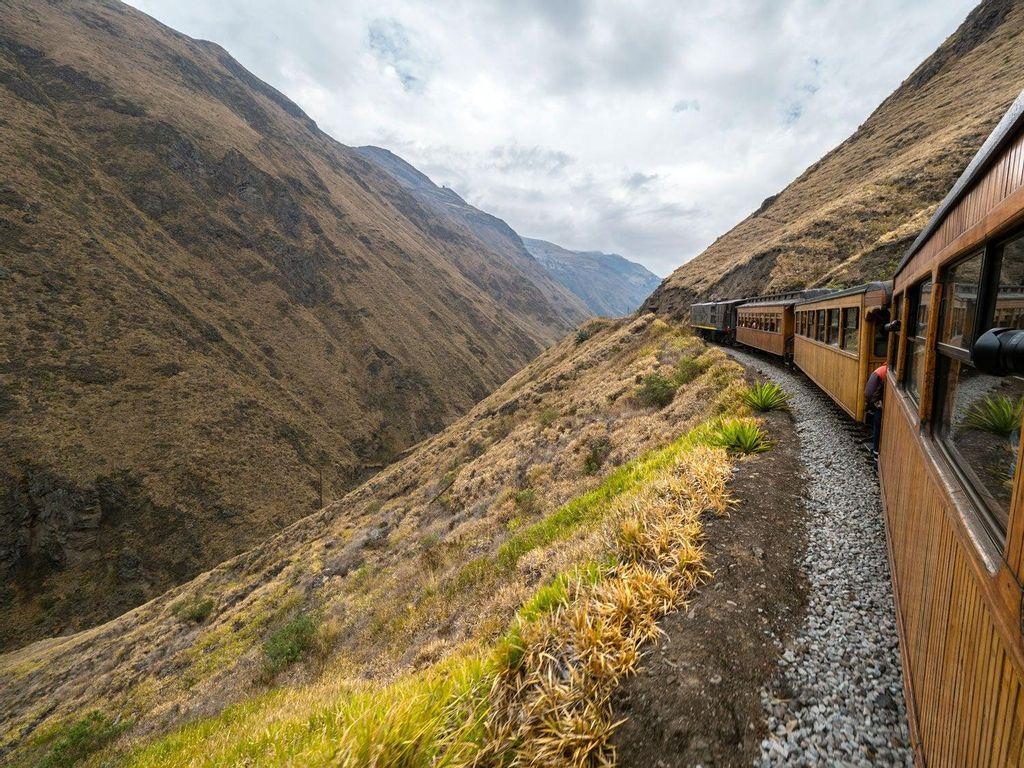
Due to the titanic construction effort, this stretch was referred to as the most difficult railway in the world. Unfortunately, not only was a Herculean technical effort required, but also an enormous human sacrifice. To construct just these thirteen kilometers of track, nearly 3,000 people lost their lives.
Explosions from dynamite, landslides, snake bites, and diseases contracted due to the deplorable working conditions were the causes of these tragic deaths, mostly of prisoners who were sentenced to death and had been promised freedom upon completion of the work.
Dizzying Heights

Today, the Devil's Nose is a segment of the Trans-Andean Railroad known as Tren Ecuador. It is also part of the route of another tourist train called Tren Crucero: an elegant locomotive with an old-world charm that, in its journey from the coast to the Andes, includes not only accommodations in scattered haciendas but also excursions and guided tours.
In any case, it is a landmark of Ecuador's rugged geography and the ultimate expression of that railway dream which allowed something that nature would never have permitted: the liberation from the yoke of peaks that challenged the integration of regions and defied dizzying heights.
Stunning Views

Along the slopes of the Devil's Nose, the trains navigate, or rather advance and retreat in a dizzying zigzag. Passengers enjoy (or endure) the jagged rocks that nearly brush against the window on one side and the deep abysses on the other.
Before your eyes unfolds the Ecuadorian mountain range, a large part of what the German scientist Alexander Von Humboldt dubbed the Avenue of the Volcanoes, that inter-Andean corridor that winds between more than 70 parallel volcanoes (27 of which are still active) over 300 kilometers. A mountain range that reaches its maximum height at Chimborazo (6,310 meters), the highest active fire colossus in the world and the furthest point from the center of the Earth.