
Verónica Zumalacárregui's Travels: Journeying from Continent to Continent 'Eating the World'

Shell upon shell. This is how the Senegalese island of Fadiouth was built, located on the Petite Côte of the African country. Clam and oyster shells crunch underfoot and have piled up over generations. Shells even exist in the walls of homes. Streets made of shells. It is one of the unique places in the world that Verónica Zumalacárregui has revealed to us in the recent episodes of the show she has hosted for eight years on Canal Cocina, I'm Going to Eat the World.
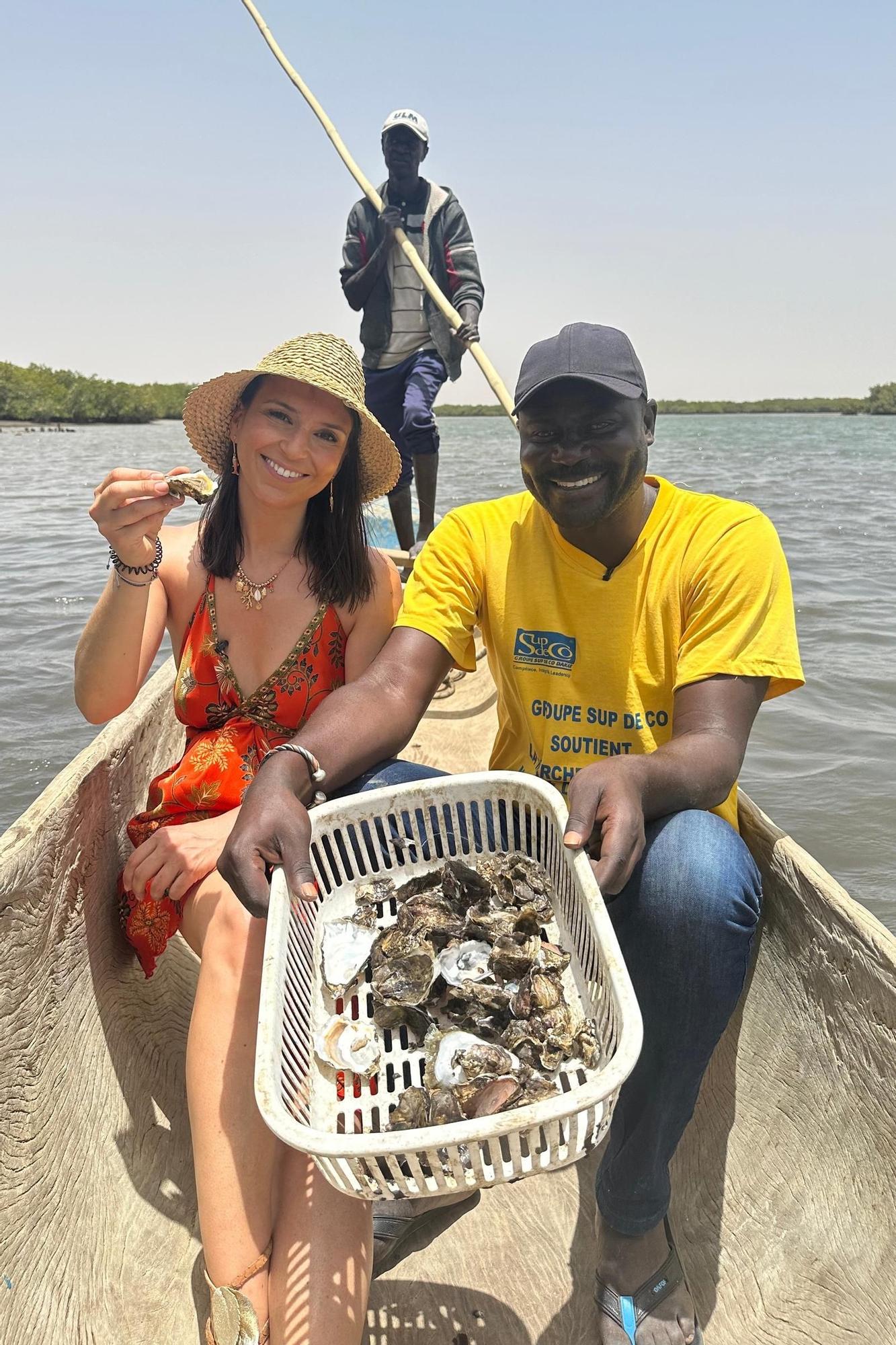
The journalist and her team have ventured this time into Africa, a continent she has yet to explore and which has posed "a real challenge." In countries like Senegal, Kenya, and Uganda, you can't keep everything so tightly organized as in other parts of the world. That "element of spontaneity" which characterizes "the show and the least routine work in the world" (as Verónica defines it) has doubled here.
"It has been wonderful to record there," the presenter tells us. "It's a very colorful continent, very lively, very sensory... All the aromas, the constant noise, the hustle and bustle, as well as the landscapes, which vary greatly from one country to another and also within the same country. We have portrayed the reality of the Maasai in the Maasai Mara in Kenya, how that tribe lives, how they eat. We went to Senegal, to Uganda... cohabiting with families, which is something very powerful that I'm Going to Eat the World has, where we sneak into the homes of locals and see how they live and how they eat."

In fact, the star ingredient of the show is precisely sneaking into the homes of citizens around the world, who share their local recipes with Verónica and thus these are immortalized on camera. "There is nothing more authentic than that. That is what I love about my job, having access to the reality of each place."
Breaking Down Prejudices
These culinary realities often generate a cultural shock, but at the same time, they are an opportunity to break down prejudices. "When I went to South Korea, I was offered dog meat, and I told the host accompanying me, 'This crosses a moral boundary for me.' And he replied, 'Look, Vero, in your country, you eat rabbit, and for us, that is a pet and seems barbaric. Here, dog became food during times of famine and is eaten less now, but there are still restaurants where you can try it.'
I sometimes eat rabbit in my country, so, why shouldn't I try it? That exercise you do when trying foods that can range from dog to Amazon lizard or turtle from the Peruvian Amazon also prompts an ethical debate; there is a reason for that, and it helps you break free from cultural prejudices."
This same exercise is what Verónica does in her book Around the World in 15 Women (Ed. Aguilar): "I specifically aim to detach myself from my preconceived ideas, from what I, as a middle-class European, have absorbed since I was young, and to approach life, even if just for a few hours, from the perspective of that Norwegian woman, divorced, who invites me to her home on a Sunday with her current husband, their shared children, her ex-husband, and the children they had, and that's just a normal Sunday! Or my Indian friend Nia, who tells me she's married a man her parents selected through Tinder for parents in India. Or even the Orthodox Jewess who invites me to her home for a Sabbath and explains why her husband is the only one who can see her hair, which she keeps covered. In the end, it is in that moment that I listen to this woman to see what she has to say. And even though I don't fully agree with this idea, I understand her point of view, and for a few seconds, I approach that way of thinking."
The first episode of I'm Going to Eat the World was filmed in Tokyo, and Verónica recalls that adrenaline-filled adventure: "We flew via Moscow. And after nearly a whole day of flying, we landed, I had to put on some makeup in the tiny hotel room where we were staying, and we started recording 16 hours that day after 24 hours in the air. We had to get around by subway, going from one place to another, getting lost because everything was in Japanese and we didn't understand anything..."
Since that first episode, there is another ingredient that cannot be missing from the show, stemming from Verónica's innate curiosity about what is in people's refrigerators. A curiosity that is not trivial, as it serves as a "X-ray of what that person is like and also a cultural portrait of that country." "You go to Nordic countries, and you'll see a lot of berries, a lot of vegetables, butter, cream. You go to countries like India, where there is a very high percentage of vegetarians, and you'll find lots of vegetables. Conversely, you go to Argentina, and it's always meat and a lot of fish. Or in Japan, where everything is in minimal quantities. Or the refrigerators in the U.S., where everything is XXL."