


Visiting the Eiffel Tower can be considered a small miracle today. In fact, it might not exist at all, as it was conceived to stand for only 20 years as a monumental gateway to the 1889 World's Fair held in the French capital.
For 42 years, it was the tallest building in the world, and although it is not even in the top 100 today, that doesn't seem to hinder its success. The Eiffel Tower is the most visited paid monument in the world, and it could not have reached this point without the determination of engineer Gustave Eiffel and the 300 workers who managed to construct it in just two years, two months, and five days-a true record construction time. And that, without any reported worker fatalities.
The process of the tower's conception and construction is part of the story in 'Eiffel', the new film by Martin Bourboulon arriving in theaters on November 12. Loosely inspired by real events, the film intertwines two of Gustave Eiffel's impossible dreams: a youthful love and the construction of the famous tower for the 1889 World's Fair. The former illustrates that social conventions can sometimes overshadow individual desire, while the latter shows quite the opposite. The engineer managed, despite numerous challenges, to raise his 1,000-foot tower, a height that no building could reach in 1889.
WHO REALLY DESIGNED IT?


Eiffel, already a renowned engineer who had just designed the internal structure of the Statue of Liberty in New York, won the competition to build a tower concept developed by two engineers from his company, Émile Nouguier and Maurice Koechlin. However, Eiffel made some adjustments to the design, turning the tower into a personal project and refusing to have it dismantled after 20 years.
At his factory in Levallois-Perret, near Paris, each of the 18,000 pieces of the tower were prefabricated, including the rivets introduced by Eiffel to replace the bolts that held the pieces together. With those permanent rivets, Gustave ensured that the tower would not be taken down, and the prefabrication of the pieces saved time on construction.
More complicated was the construction of the foundations on the side of the tower facing the Seine. The soil's moisture in that area made the work hazardous, but Eiffel's team also had a solution: they used compressed air caissons that allowed workers to work below water level. The legs, which began assembly on July 1, 1887, rested on concrete foundations, installed a few meters below ground level on a bed of compact gravel. The orientation of the legs and pillars was determined based on cardinal directions.
Eiffel also knew that once they assembled the first level, they would be able to rise about 20 meters per month. For this, they used wooden scaffolds and small steam cranes fixed to the tower itself. The connection of the large beams of the first level, perhaps the most critical moment of construction, was completed on December 7, 1887. The first level was fully finished on April 1, 1888.
Almost a year later, on March 31, 1889, the work was completed, and so were the criticisms. These had begun almost simultaneously with the start of construction, when a group of artists, including renowned names like Guy de Maupassant, Alexandre Dumas fils, and Charles Garnier, signed a protest in the newspaper Le Temps attacking the tower. They could not reconcile the supposed ugliness of this wrought-iron skeleton amid so much Parisian beauty. However, during the 1889 exposition, the tower received two million visitors, all interested in seeing the views of all Paris from the tallest monument in the world at that time. Today, about seven million people seek that dizzying experience each year.
MORE THAN JUST A TOWER


Additionally, Eiffel ensured visitors would be attracted to the tower by making it not just a simple viewpoint, but also a recreational space that included shops and restaurants. In fact, at that initial moment, it had four, all on the first level: one Russian-style; another Anglo-American; one French; and one Flemish. Today, there is no trace of them, as they were demolished for the International Exposition of 1937, when the first floor of the tower was completely remodeled.
At that time, they were replaced by two establishments that, in the early 80s, became La Belle France and Le Parisien, which were unified in 1996 into the café-restaurant Altitude 95. In 2008, this was renamed 58 Tour Eiffel, and it is currently under renovation, expected to reopen in 2022 with Michelin two-star chef Thierry Marx at the helm.
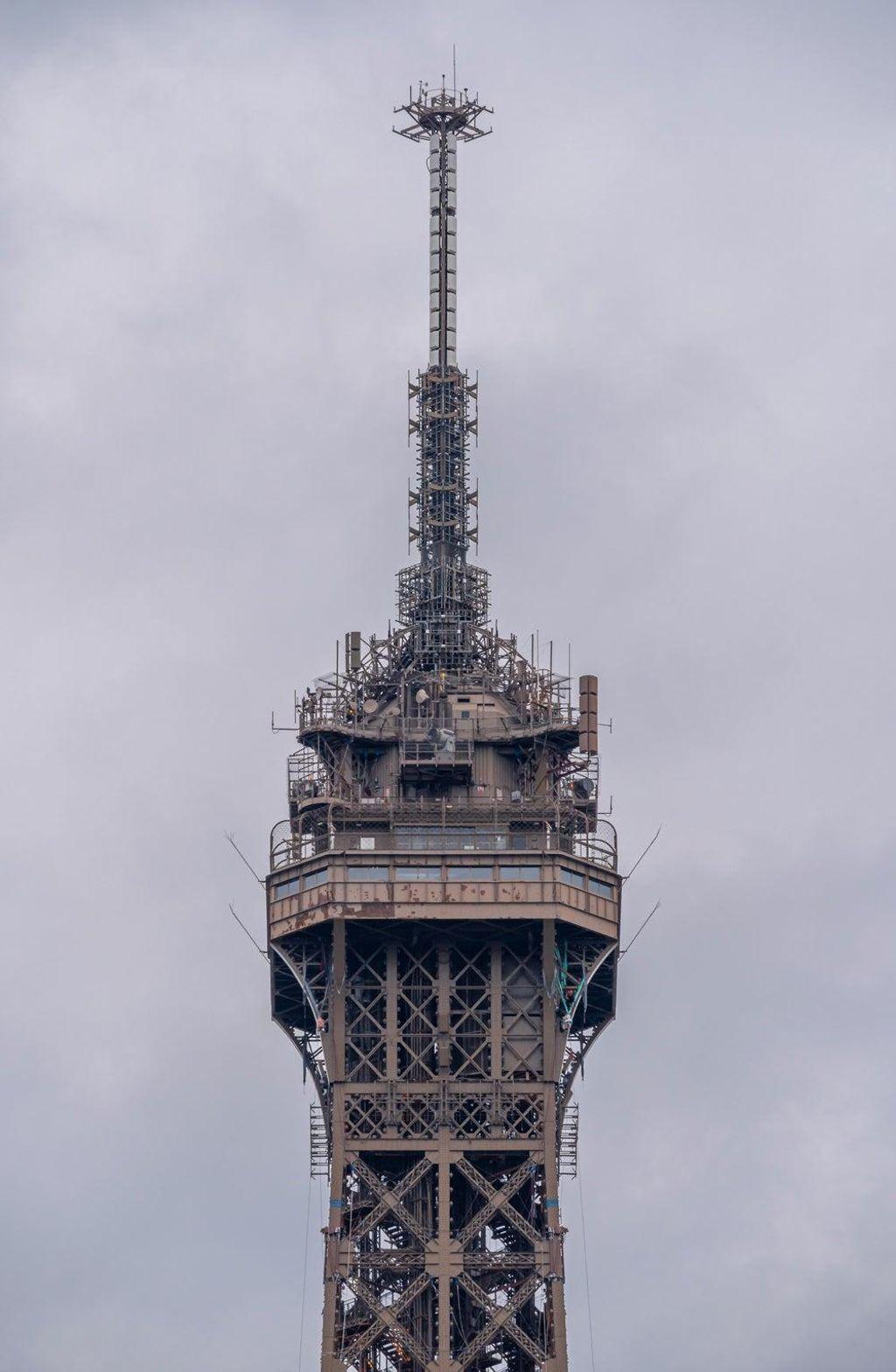
Gustave also conceived another continued use for his construction: that it would serve as a site for experimentation, science, and meteorology. From the Eiffel Tower, experiments on air resistance have been conducted, telegrams have been sent using electric waves, it has been used for meteorological observation, and it has functioned as a giant antenna for radio transmissions. This last function is what truly saved it from destruction, as today the highest area of the tower accommodates 120 broadcasting antennas, including both television and radio, which have notably increased the tower's height over the years to its current 324 meters.
Eiffel left a mark of science on the tower by inscribing the names of 72 scholars, including physicists, mathematicians, and naturalists. These names have survived to this day somewhat by coincidence, as a painting campaign at the beginning of the century erased them, but they were re-inscribed in 1986 and 1987.
IN BETWEEN PAINTS

In the movie Eiffel, we see that the tower was not presented in the dull gray color of iron at its inauguration but was painted, something that continues to be done every seven years. The reason? Eiffel was clear: to protect it from oxidation; the more it was painted, the longer it would last. That is why this process continues to repeat every seven-year cycle to this day, having already reached the number of 19 repaints.
But it hasn't always shown the same color. In the 1950s, it was painted a reddish-brown color (known as Eiffel Tower brown, which degraded in three shades from dark at the bottom to light at the top), while at its inauguration, it was ochre-yellow. Currently, the tower is undergoing painting and is expected to showcase a more golden color by 2022, reportedly the one desired by Eiffel. About 50 painters, specialists in high metalwork and poles, are in charge of this.
AND ALSO


Those wishing to know more about the love story between Gustave Eiffel and Adrienne Bourgès, the main plot of the movie Eiffel, can read 'La vraie vie de Gustave Eiffel', a book by Christine Kerdellant about the more personal side of the French engineer. Without revealing too many details, this will help explain why the Eiffel Tower has that particular shape.