
Guadalupe: The Cult of a Dark-Skinned Virgin Who Crossed the Atlantic Ocean


The history of Spain and America has paraded through the Royal Monastery of Guadalupe, the imposing walled complex that is, at the same time, a convent, church, and castle, rising majestically over the maze of valleys that make up the Extremaduran region of Las Villuercas. Here, in this southeastern region of Cáceres where the landscape is fresh and rolling, this monument provides a stone contrast to the old mountain ranges that give way to wooded areas, to the web of rivers and streams that are home to thousands of migratory birds.
Nestled on a hill that crowns the village of the same name, this monastery is the jewel of the area. A sanctuary enlarged over the centuries, it would eventually become an icon of discovery at the hands of the Extremaduran conquerors. For within it rests the dark-skinned Virgin, who is not only the patroness of Extremadura but also the queen of Hispanicity. Thus, it is also a place of pilgrimage to admire a figure that is the object of extreme devotion.
Beautiful Legend

But let's break it down and focus on its construction, which was commissioned in 1330 by King Alfonso XI. The idea was to build it in a place of oaks and holm oaks, the same one where, according to legend, the Virgin appeared before the humble shepherd Gil Cordero, who found one of his cows dead. With her mere presence, she enabled the animal to come back to life, while announcing to him that, underground, he could find his own figure carved from cedar wood.
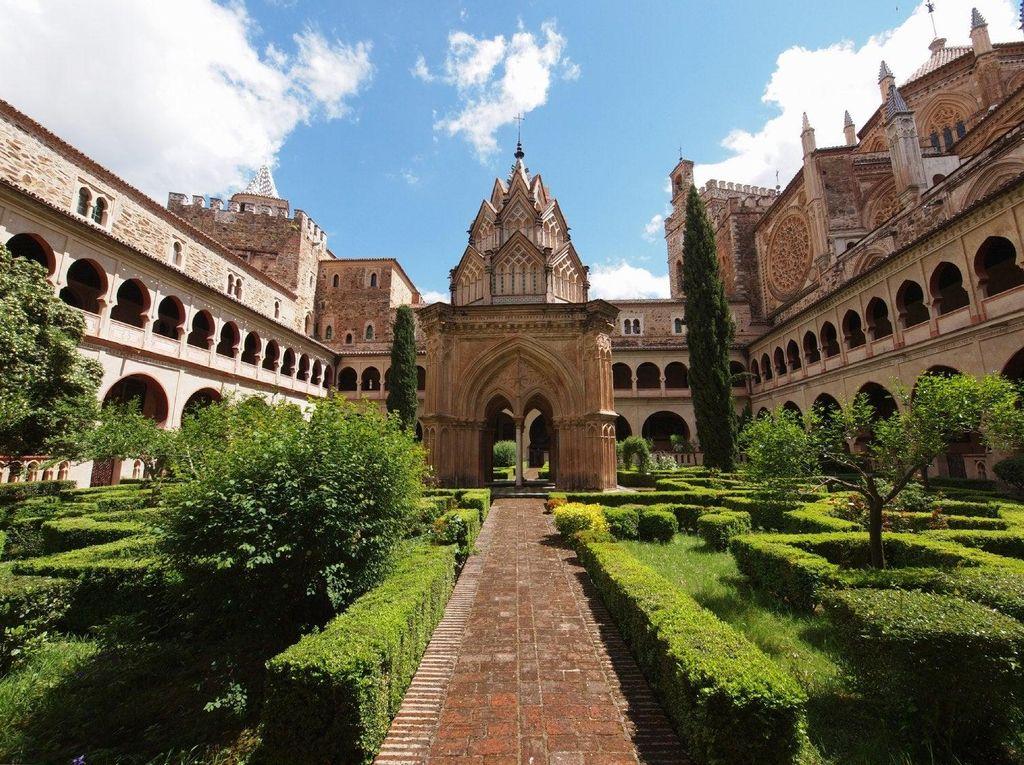
Thus, the tradition of its miracles was born, which years later the monarch would affirm by attributing to the Virgin of Guadalupe his victory over the Moorish troops in the Battle of El Salado. And so the monastery acquired a value that transcends religious significance. Not only was it expanded, but the devotion also spread across the seas, elevating the dark-skinned Virgin to be the most venerated in the New World. Even Christopher Columbus named an island in the Caribbean after her.
Chapters of History

A witness to time like no other, this sanctuary has seen remarkable episodes unfold. Such as when, at the convent's fountain, the two Indigenous people that the discoverer brought along were baptized to become translators. Or when the Catholic Monarchs thanked the Virgin for their significant conquest of Granada. Or when Miguel de Cervantes himself offered her the shackles and chains of his captivity in Algiers, in an act of tribute he documented in one of his novels: "Virgin of Guadalupe, freedom for captives, file of their irons and relief of their prisons," he wrote in "The Works of Persiles and Sigismunda."
Even today, long after, it observes the scenes that prompt the streams of pilgrims arriving on foot, either to fulfill a promise or because they are hiking in a pleasant setting that culminates, in due course, at one of the most beautiful monuments in the country. The Royal Monastery that was declared a National Monument in 1879 and was awarded the designation of World Heritage by UNESCO in 1993.