
Land Art: When the Landscape Becomes the Canvas
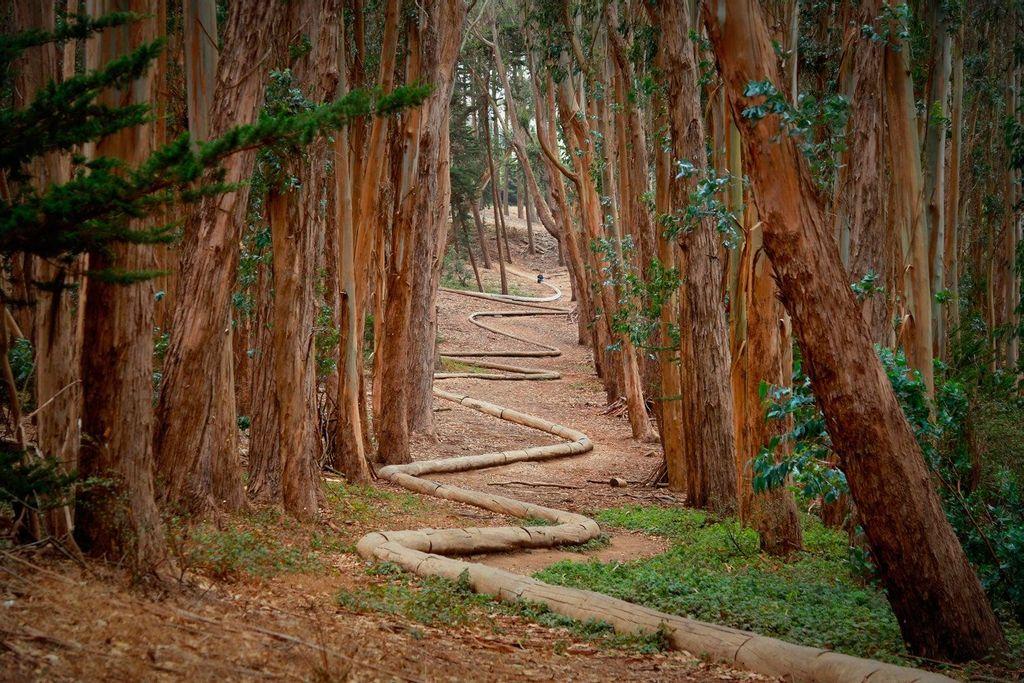


Traditional art had become monotonous for these two American artists when they decided to experiment beyond the various colors and dimensions that can be portrayed on a canvas. It was when they began to consider art in its different forms, when they decided to make the place the real artwork, not just its drawing, and when they created their first works in the desert landscapes of the American West.
With the elements of nature at the center of their creation, Spiral Jetty is one of the most well-known works of Robert Smithson. Built in 1970, it is located in northern Utah, at the Great Salt Lake. It is currently open for visits, although its appearance, nearly 50 years after its construction, has been affected by climatic changes.
This work involved the participation of hundreds of men and the use of machines, as it consists of 5 tons of black basalt. Another of his renowned works is Broken Circle, located in Emmen, Holland.
Additionally, Michael Heizer created a work in 1969 that involved excavating and moving 240,000 tons of sandstone, which he subsequently deposited in the Virgin River in Nevada. He titled his work Double Negative. Among his more recent works is Levitated Mass, a 340-ton rock placed on a concrete trench located at the Los Angeles County Museum of Art (LACMA).
The works created by artists in this movement are very varied, ranging from the largest, made with excavators, to the smallest and least impactful on the terrain. Among the latter are those made by Andy Goldsworthy, Nils Udo, or Richard Long. Despite the differences in their size and construction, these creations share the fact that they are changeable and almost always ephemeral, due to the passage of time and exposure to the whims of nature itself.
Among the creations of these artists, we can find Hanging Trees at Yorkshire Sculpture Park, and Green to Yellow Leaves by Andy Goldsworthy, along with Bamboo Nest, a large-scale circular nest, or Waterhouse, a collection of logs placed on the shore of the Wadden Sea in Holland, by Nils Udo.
Years after the inception of land art, other artists joined this movement, trying to create a contrast with the natural environment using artificial materials, such as Christo and Jeanne Claude, and Walter de Maria. Due to the significant impact of their works on the environment, some of them had problems with ecological associations that sought to prevent the construction of their projects.
Christo and Jeanne Claude, a couple dedicated to land art on a grand scale, placed a large cloth of 400 square meters between a valley of rocky mountains near the city of Rifle in Colorado in 1972. This work is known as Valley Curtain and was taken down 28 hours after its installation due to weather conditions.
Another piece by this couple is Running Fence, an extensive sheet of metal nearly 40 kilometers long that they placed across the hills of Sonoma and Marin in northern California, ending at the sea. Erected in 1976, it referenced the Great Wall of China and lasted 14 days, similar to Surrounded Islands, a creation that involved placing a fuchsia fabric in Biscayne Bay, Miami in 1983.
After the death of Jean-Claude in 2009, her husband Christo Vladimirov Javacheff created The Floating Piers, a giant walkway 3 kilometers long and covering an area of 100,000 square meters on Lake Iseo in the Lombardy region of northern Italy. It was open for visits until July of that year.
Due to their characteristics, observing many of these works in their entirety has required the use of helicopters, not only for viewing but also to record them for the future using aerial photography.
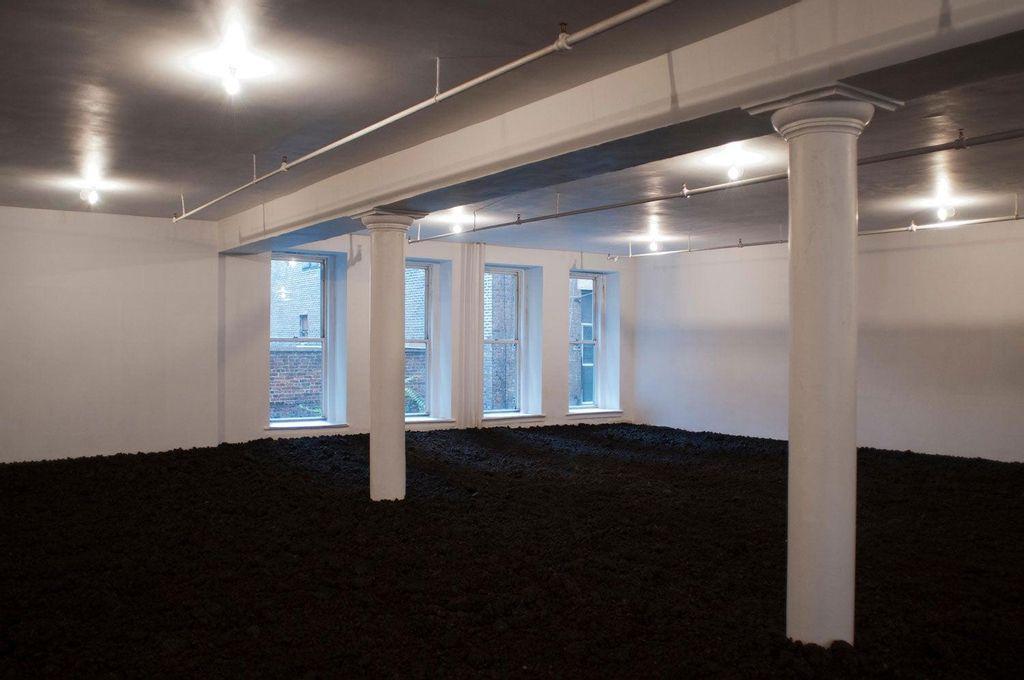
In contrast to land art, Walter de Maria installed his natural work within a gallery. This piece is known as The New York Earth Room and to this day collects a large number of cubic meters of soil inside a gallery, allowing the viewer to interact by sinking into or playing with it. Since 1977, the gallery has maintained the soil in perfect condition, ensuring that nothing grows in it.
De Maria is also the author of Lightning Field, a work created in 1977 that consisted of installing 400 metal poles in a field in Quemado, New Mexico, intended to act as lightning rods. During a storm, the lightning was attracted and concentrated in one place, creating this fleeting and ephemeral work that only remained in photographic records.
On the other hand, combining the use of natural and artificial materials, artists like Robert Morris aim to stage the forces of nature and cosmic order. Morris does this with works like Observatory, inspired by megalithic circles such as Stonehenge and located in Flevoland, Holland, or with Steam, a piece where he interacted with atmospheric conditions. Its purpose was to experiment with how a cloud of steam transforms, establishing various steam outlets over a stone base on the campus of Western Washington University in the United States.
Douglas Hollis also works with the forces of nature, emphasizing sound sculpture. Aeolian Harp or Zephyr Trio are some of his creations, showcasing the power of the wind. Both are located at the Exploratorium in San Francisco, California.
Finally, it is worth highlighting the figure of James Turrell, who in 1974 created an artful astronomical observatory from an inactive crater in Arizona, with sunlight as the main element. Over the years, this artist has crafted his own landscape within the crater by digging tunnels and opening small chambers inside. This observatory is known as Roden Crater and is located near the city of Flagstaff in Arizona.
Light also plays an important role in many of Turrell's works, such as Meeting at the MoMA in New York, or Irish Sky Garden located in Skibbereen, County Cork, Ireland.