
- 1. The map of typical proverbs from each Autonomous Community in Spain
- 2. Typical Proverbs from Spain: Community to Community
- 3. Andalusia
- 4. Aragon
- 5. Asturias
- 6. Balearic Islands
- 7. Canary Islands
- 8. Cantabria
- 9. Castilla-La Mancha
- 10. Castilla y León
- 11. Catalonia
- 12. Extremadura
- 13. Galicia
- 14. Community of Madrid
- 15. Region of Murcia
- 16. Navarre
- 17. Basque Country
- 18. La Rioja
- 19. Community of Valencia
The map of typical proverbs from each Autonomous Community in Spain

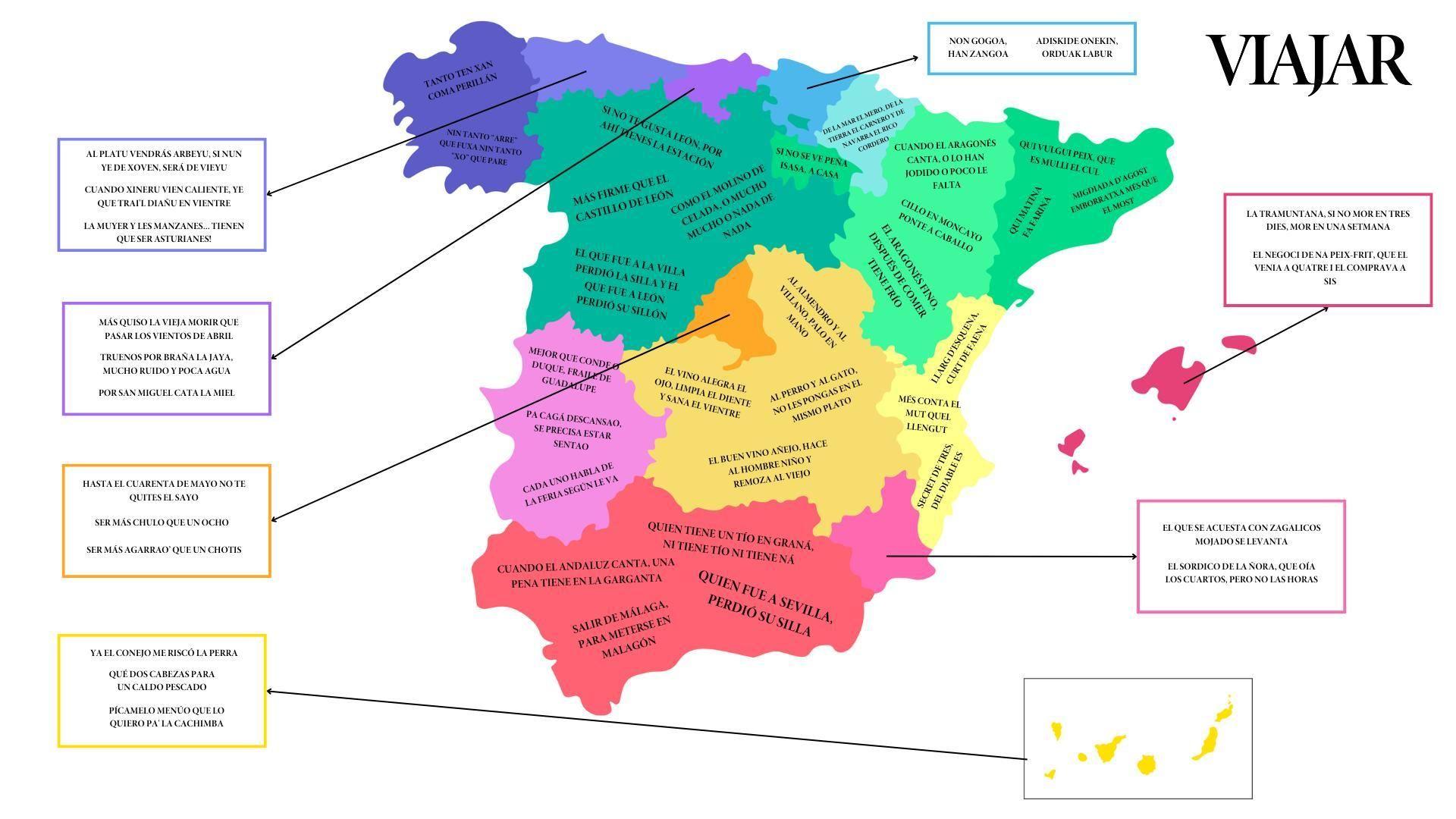
We saw it in literature, and more specifically, in one of the most important books in history written in Spain: Don Quixote. Who doesn't remember Sancho Panza always talking with proverbs in his mouth while they traveled through the most emblematic places of La Mancha? A community that still embraces proverbs and has left us such mythical phrases as, "Greed breaks the sack."
Today we highlight the Spain of proverbs, those that our grandparents used to say that explain life through phrases deeply connected to our country's life, customs, and landscapes. Here is a sample of some of the hundreds we can find in our country, which we simply believe should return to contemporary language. Because knowing the proverbs and languages of Spain is also traveling, and that... we love!
Typical Proverbs from Spain: Community to Community
Andalusia
"Whoever has an uncle in Granada, has neither an uncle nor anything"
This proverb tells us that it is of little use to boast if one's words are not backed by corresponding actions.
"When the Andalusian sings, he has a sorrow in his throat"
Singing makes sorrows lighter, and the Andalusians know this well. Whatever happens in life can be faced better with a good attitude and a few songs.
"Whoever went to Seville lost his chair"
If you leave a place for a moment, you may lose a good opportunity. How many times have you used this proverb? We certainly have countless times.
"Leaving Malaga to get into Malagón"
Leaving one complicated situation only to enter an even worse one. Whether you live in Andalusia or any other autonomous community, this expression is always a basic of the popular proverbs.
Aragon
"When the Aragonese sings, either he has been wronged or it is very close"
A way of saying that something is not going well. It is an adaptation of the Andalusian proverb 'When the Andalusian sings, he has a sorrow in his throat', but also demonstrates divinatory abilities if the misfortunes have not arrived yet.
"The fine Aragonese, after eating, feels cold"
This proverb has been adapted and is used throughout Spain, changing the term Aragonese to Spanish.
"If it's cloudy at Moncayo, get on a horse"
If the sky is very gray towards Moncayo, a downpour is assured and it is best to run for cover.
"Like Pedro in Huesca"
The expression 'Like Pedro to his house' originated in the late 11th century and is an evolution of this Aragonese phrase.
Asturias
"If you see the beans bubbling in the pot, grab the cider to drink"
Enjoy a splash of cider because the food is almost ready and it's time to set the table.
"To the plate, you will come pea, if not when young, then when old"
If you don't want something at a certain moment, you will want it at another moment. Life is long, and what doesn't serve at one time might be tremendously useful at another.
"When January comes warm, it's because the devil is in the belly"
Proverbs can give us clues about climate change. And if it's warm in January, something bad is happening.
"The woman and the apples... they must be Asturian!"
Clearly expressing Asturian pride, both for its female population and for the apples that yield the cider that has granted them worldwide fame.
Balearic Islands
"The tramuntana, if it doesn't die in three days, dies in a week"
About the duration of these winds that occur especially in the Balearic Islands. It seems that if it lasts less than three days, the ordeal extends for at least a week.
"You made the deal of the fried fish, buying it for six and selling it for four"
This refers to a legend where a woman seemed foolish for buying expensive fish and selling it cheaper, but she had a trick: she coated the fish plates with glue and when she went to retrieve them, she managed to get coins or some treasure.
"Oh, little horse, when you were young... how well you were groomed..."
This expression refers to the effects of time on people.
"Looking for Mary in the kitchen"
You don't need to know any Mary to say this proverb, as it essentially means complicating life.
Canary Islands
"The rabbit already gnawed the dog"
This phrase is used when something goes wrong, or a plan goes awry. The origin is found in hunting dogs that sometimes died while chasing rabbits.
"What two heads mean for a fish stew"
Commonly used in the islands, this proverb emphasizes the lack of intelligence or the clumsiness of someone. Some people use it to say that someone "drives them crazy."
"Cut it smaller, I want it for the pipe"
This phrase is used for situations when discussing a topic you have little knowledge of and can't follow. It serves to ask for a detailed explanation of something you don't understand.
Cantabria
"The old lady would rather die than go through the winds of April"
April winds in Cantabria are intense, so this proverb transmits that the whole population struggles during these weather conditions.
"For San Miguel, taste the honey"
September 29 is San Miguel, and by then honey should be harvested, making it the perfect time to taste it.
"Thunder in Braña de la Haya, much noise and little water"
Braña de la Haya is a town in Cabuérniga, where it tends to thunder quite loudly but doesn't rain too much, although the noise seems to announce a great storm.
"Much from Boo and little from Guarnizo"
In other words, this saying that refers to the village belonging to the municipality of El Astillero could be translated as "much talk and little action."
"Good old wine makes a man feel young and rejuvenates the old"
Aged wine is one of the most treasured and beloved in Cantabria. This proverb refers to this fact. Especially in the past, teenagers drank wine (even children), and this phrase reflects that.
"Wine cheers the eye, cleans the teeth, and heals the belly"
It's true that excess wine can be harmful, but in small amounts it can actually be beneficial to health.
Castilla-La Mancha
"Good wine resurrects the pilgrim"
Castilla La Mancha has a number of proverbs dedicated to wine, including this one that highlights the importance of quality wine.
"To the almond tree and the villain, stick in hand"
By the end of March, the almond trees bloom in this territory, and this proverb that speaks of this tree also reminds us what to do with those we are at odds with.
"Don't put the dog and cat in the same plate"
This expression refers to the poor relationship that some animals or even some people have.
Castilla y León
"Whoever went to the town lost his chair, and whoever went to León lost his armchair"
This proverb is used in different places in Spain, and the cities mentioned change depending on who is saying it. The version from Castilla and León could be none other.
"More firmly than the castle of León"
This other proverb refers to an emblematic site in León: a castle that has withstood since the 10th century, and is a must-see in the city.
"Like the Celada mill, either a lot or nothing at all"
To speak about irregular behavior, one can use this proverb, which emphasizes that sometimes a middle ground cannot be found. The Celada Mill was the mill of La Retortilla, known for its excess when it spun in any direction.
"The bread of Astorga, much in hand and little in the belly"
The mantecadas from Astorga are traditional breads from the area. Similar to muffins, written references have been dating back to 1805. Everyone visiting Astorga must try these treats.
"Three things León has that Madrid doesn't: San Marcos, an orphanage in the garden, and the Cathedral"
The Convent of San Marcos, the Garden of San Francisco, and the "Pulchra Leonina" are three spots loved by the people of León that, according to them, cannot be compared to Madrid.
"If you don't like León, there goes the station"
This proverb is not very difficult to understand: if you don't like the city, you can go visit others.
Catalonia
"Whoever speaks ill of summer doesn't know what they say"
Dedicated to all those who complain about summer heat.
"Who wants fish, must wet their behind"
An original form of a very common saying; whoever wants something must be prepared to work for it.
"August siesta intoxicates more than the must"
Referring to summer naps, those taken without checking the time, and from which we can wake up a little or very tired.
"Whoever rises early, makes flour"
It would be the same as saying: "God helps those who help themselves."
Extremadura
"Better with a monk from Guadalupe than a count or duke"
An old proverb that referenced the economic power of the monks of the Jerónimos of Guadalupe.
"Neither a black donkey nor a man named Pedro"
Used when saying it is neither one thing nor the other.
"To break wind comfortably, one must be seated"
A popular way to say that things must be done properly.
"Everyone talks about the fair based on their own experience"
It refers to how the perspective of a subject will always be different depending on who tells it.
Galicia
"So much has Xan as Perillán" - "So much has Sarria as Portomarín"
It is used in circumstances where there are two equally good or bad options, to signify that it doesn't matter which one you choose.
"Who has a butt has fear"
Quite literal, it's a sarcastic way to show that fear affects us all in one way or another.
"Neither too much 'go' that it escapes nor too much 'stop' that it stays"
There is a very common Spanish version of this popular saying: "neither too much nor too little."
"The holidays are announced in the evening"
Another Galician proverb with a translation to another widely heard saying in daily life: "it couldn't be known."
Community of Madrid
"To be more tight-fisted than a chotis"
Refers to the Madrid dance where partners hold each other closely. It refers to someone who is very stingy or not generous at all.
"Not before the forty of May should you take off your cape"
It originates from the 19th century and refers to the unpredictable weather in the center of the peninsula.
"Not eating a single roll"
Used for both someone who can't find a partner and when one does not achieve something they set out to do.
"To be more cocky than an eight"
Originates from the tram line 8 in Madrid, where many chulapos would board. It refers to someone who is conceited or very arrogant.
Region of Murcia
"Whoever hangs out with a cripple, if after a year they don't limp, they'll surely hobble"
A proverb that talks about all the vices and habits that can transfer from one person to another. For example: if a non-smoker hangs out with a smoker... they'll likely end up smoking or at least trying it.
"Whoever gets into bed with wet children will get up wet"
Talks about how children will always behave like children. A reflection that indicates if you do something with them, don't expect them to act like adults.
"Each little dog licks his own pie"
Used to say that everyone must do their own duties or tasks, without waiting for anyone else to do them.
"The deaf man from La Ñora, who heard the coins, but not the hours"
Used to refer to people who only hear what they want to hear.
"In September, it either dries up the sources or takes the bridges away"
In Murcia, it is quite common for September to either be a month of drought or a year of flooding. This proverb is used to refer to these yearly changes that are unpredictable.
Navarre
"San Cristóbal with a hat, water to the muzzle"
San Cristóbal is a mountain near Pamplona. This proverb expresses that if clouds start to gather over this mountain... a heavy downpour is likely.
"From the sea the grouper, from the land the ram, and from Navarra the rich lamb"
An expression that highlights the rich lambs that can be eaten in Navarra. It suggests that they do not refuse to eat anything: neither the grouper nor the ram. But if you want to eat well, then you have to enjoy a good lamb.
"The rain of San Fermín, ends in a few hours"
Talks about when it rains during the famous San Fermín festivals in Navarra. An expression that reassures that there's no need to worry because the rain will leave just as quickly as it arrives.
"Whoever goes to the store and comes back, maintains two homes"
Refers to people who come and go from their homes without any apparent reason. An expression that reflects someone may be living a parallel life to their main home.
"For San Antón, frost; for San Lorenzo, heat"
There are several sayings that refer to San Antón, a saint associated with the influence of weather and short- and long-term weather predictions. This one means that if it's cold during the San Antón celebration... it's expected that it will be very hot for San Lorenzo.
Basque Country
"Wood, measure it twice and cut it once"
Talks about how we can avoid wasting materials and labor due to an incorrect cut. In other words: think twice before acting.
"With a good friend, hours go by fast"
A proverb that highlights the love among friends, those people with whom time seems to fly.
"Where your feet go, there go your thoughts"
One of the most beautiful phrases in the Basque proverb collection. It speaks of how there is one thing that will always accompany you wherever you go: your thoughts. For us, it's one of the most beautiful expressions of all.
"Txapela on your head and travel the world"
Talks about the need to explore the world without forgetting your homeland: your beloved Basque Country represented by the txapela.
"A Basque's promise is not the foam on top of the water"
A proverb that expresses that Basques' promises are not superficial. If a Basque promises you something, they will do it no matter what.
La Rioja
"A year with many sloes, few grains"
Warns that the year when this fruit is abundant usually has a scarce grain harvest.
"Thunder in May, takes away wine and gives grain"
States that storms in May usually harm the vineyards, but are very productive for cereals.
"If Peña Isasa is not visible, homeward bound"
In the area of Arnedo, it is said that when Peña Isasa is hidden by clouds, it foretells cold or rain.
"Whoever eats sardines as a youth, poops thorns when old"
Talks about the consequences of youthful excesses that one will likely pay for with health issues in old age.
"For San Andrés, it's wine must"
In the time around San Andrés celebrations, it's typical to taste the wine of the year.
Community of Valencia
"Four eyes see better than two"
A proverb that speaks about the benefit of having things reviewed by more than one person rather than by one alone.
"Long of back, short of work"
A proverb that refers to someone who is very tall... probably they are not very hardworking. Although we don't believe this is the case...
"Secret of three is of the devil"
Indicates that if a secret is known by three people, it's really not a secret anymore.
"The mute tells more than the one who runs off at the mouth"
If a man is chatty, he likely won't say anything of substance. On the other hand, it suggests that quiet people are, in fact, the ones who kill with their silence. No better way to say it.
"For real for real, like eating pears and shitting them whole"
Used when you tell something to someone and they show skepticism or distrust.