
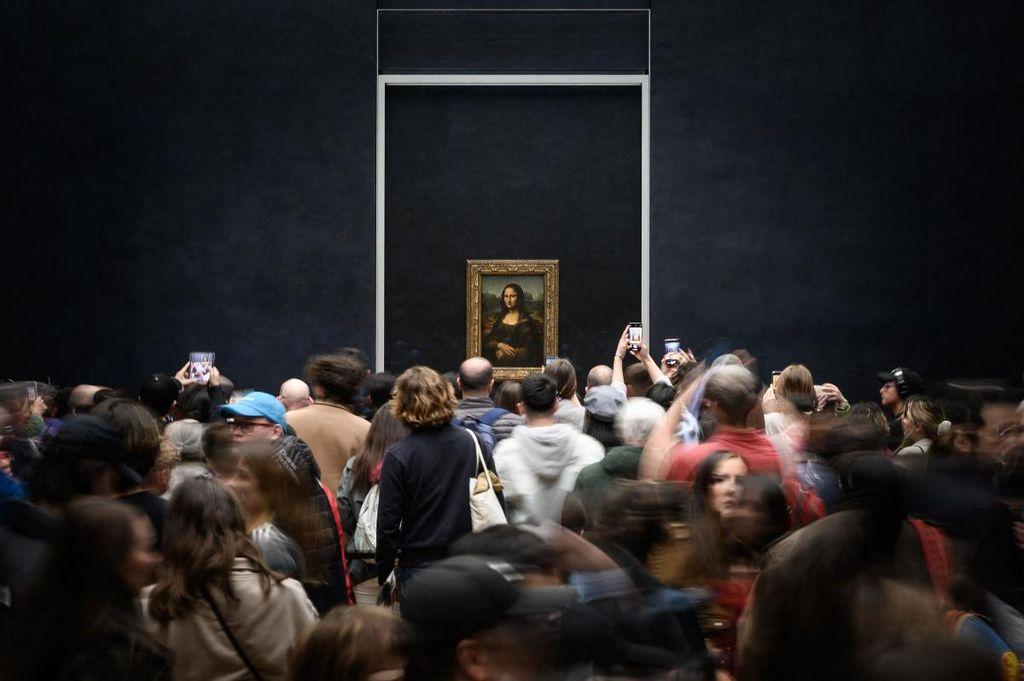
The traveler arriving at the Louvre for the first time does so mainly to see the Mona Lisa, one of the greatest works in the history of art. Even today, half a century after Leonardo Da Vinci completed his work, it remains an enigma for the general public.
According to a study from the French museum, 80% of its visitors arrive with the intention of seeing the Mona Lisa to try to decipher all the secrets of that smile and gaze that move the viewer, making them feel they are facing a work that shines more for what it conceals than for what it shows.

At the end of January, Leonardo Da Vinci's painting made headlines again, but unfortunately, not in the way we would like for all of us who love art. Two climate activists from the French environmental group Riposte Alimentaire threw soup at the painting to protest for the right to sustainable and healthy food. The incident did not escalate because the artwork is protected by glass, but the room was closed off for necessary cleaning.

Today, we revisit Leonardo Da Vinci's work because new information has emerged that might challenge the identity of this enigmatic woman. Until now, there was a general consensus that the subject of the painting was the wife of a wealthy merchant. Moreover, the Mona Lisa was the wedding portrait of Lisa Gherardini, wife of a merchant known as Giocondo. Hence, the name of the artwork.

The Italian researcher and art historian Carla Glori works at the University of Turin and has dedicated part of her career to researching Da Vinci's works. For several years, she has maintained that the identity of the Mona Lisa does not correspond to Lisa Gherardini, and this is evident from her recent articles and scientific publications. In October 2023, she published the study The Mona Lisa - Summary of Research, New Discoveries in which she reveals her identity and the steps and investigations carried out to support her thesis.
Glori's investigations are based on the study of the landscape. But let's go back a few centuries to discover the context. Leonardo Da Vinci painted the Mona Lisa between 1503 and 1519. During that period, the artist moved to Bobbio, a small city located in the province of Piacenza (in northern Italy), and worked under the orders of Galeazzo Sanseverino, the marquis of the region, who acted as his patron.
According to Carla Glori, the woman in the portrait is none other than Bianca Giovanna Sforza, the marquise of Bobbio. This could start to make sense, as the landscape depicted in the painting would correspond to the Trebbia valley, where Bobbio is located.
The researcher from the University of Turin has drawn these conclusions after conducting a paleontological study of the landscape and provides more data: the subject might be facing away from the Malaspina dal Verme castle, where the marquises lived, and situated near the bridge of Bobbio, which peeks over her left shoulder.
Ultimately, Glori's thesis is quite reasonable and may lead us to think that the Mona Lisa is not the wife of Francesco del Giocondo but the marquise of Bobbio, Bianca Giovanna Sforza. And you, which thesis do you prefer?