
Olympus Mons on Mars
The Highest Mountain in the Solar System


Our galaxy is filled with planets that scientists on Earth want to explore to gather information about their characteristics and mysteries. Mars is the preferred study for researchers due to its proximity to our planet and the relative ease of access to its surface. The average distance between Earth and the Red Planet is approximately 225 million kilometers, but it is very important to highlight that this distance is relative as the position of the planets can alter the space that separates them, making the study of Mars more complicated.
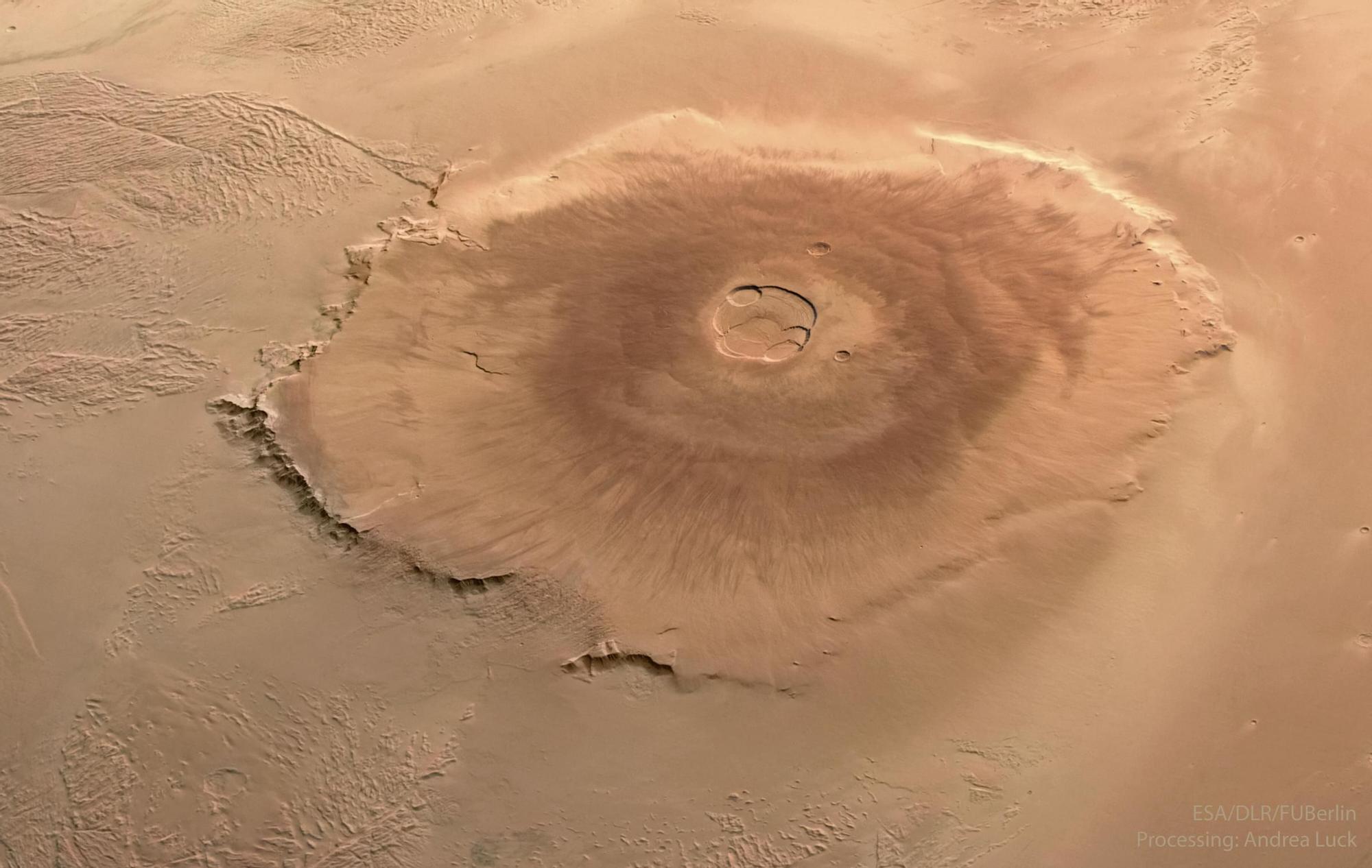
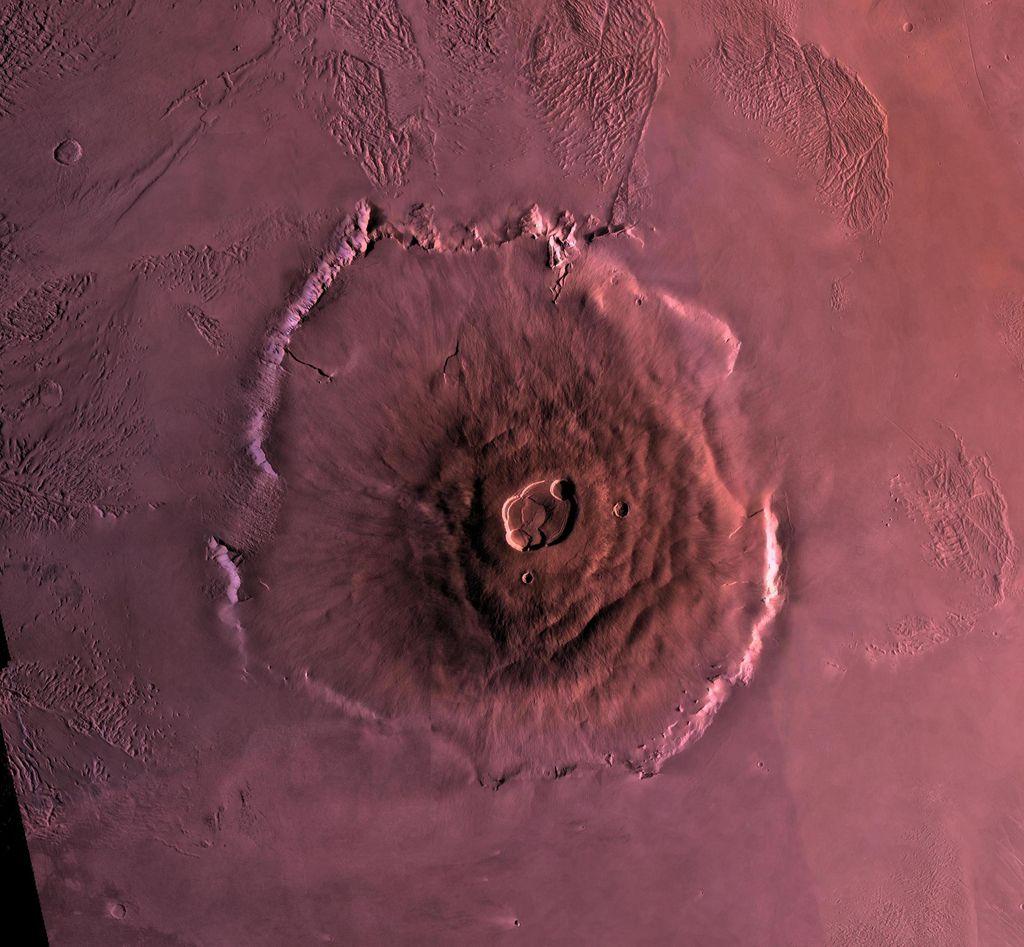
The incredible discoveries that have been made represent significant advancements for experts as we are getting closer to fully understanding our neighboring planet. One of the most important findings is Olympus Mons, considered the highest mountain in the Solar System. It has earned this honor due to its staggering height of 22 kilometers. However, it is not an ordinary mountain; it is an extraordinary volcano that surpasses any of the tallest peaks on our planet.
This impressive landmass is also known by its Latin name, Olympus Mons. Interestingly, despite its enormous size, it cannot be seen with the naked eye from Earth, and in the nineteenth century when study began, researchers only saw a vast spot. What astronomers like Giovanni Schiaparelli would discover years later is that behind that dark mark was an impressive volcano through which incandescent rivers flowed at one time. In fact, the existence of Olympus Mons was known long before the probes reached the planet, and it is estimated to have formed during the Amazonian Era, a period that spans from 1.8 billion years ago to the present.
The volcano is located in the western hemisphere of Mars and is one of the youngest due to its formation during the Amazonian Era. It exceeds the size of Mount Everest and the stratovolcano Nevado Ojos del Salado, located in the Andes, which measures 6,891 meters. Nothing compares to the magnitude of Olympus Mons; in fact, if it were possible to set foot on Mars, seeing the volcano in its entirety would be an impossible mission as the curvature of the planet and its great size make it impossible to view it completely from any point on the Red Planet. In recent investigations, NASA found a river of lava flowing from the volcano, confirming that its activity is still present today.
Its height is not the only impressive factor; its span must correspond with it, and its extension is also immense. A total of 600 kilometers in radius forms the surface of 283,000 square kilometers of Olympus Mons. This volcano, discovered in the 1970s, has a caldera that is 85 kilometers wide, 60 kilometers long, and 3 kilometers deep. Undoubtedly, it is a giant among mountains that scientists and astronomers will continue to investigate to learn more about its creation and future.