
Pareidolia
Architectural Pareidolia

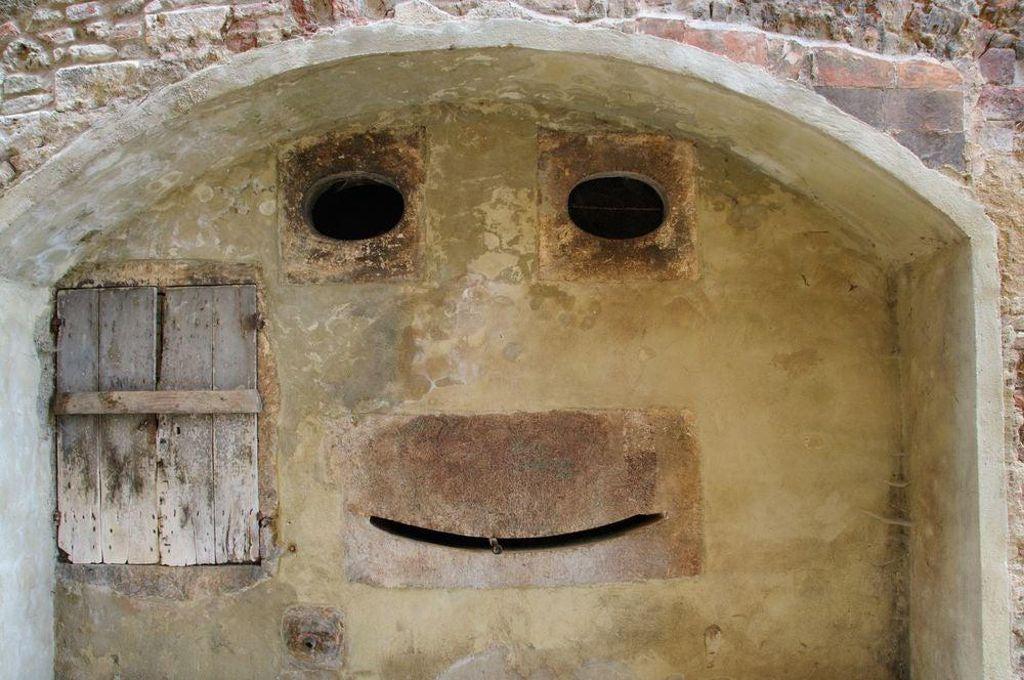







Believing you see a sleeping woman in a mountain range, a cloud shaped like a bear, a bull's head among the stalactites of a cave, or human faces on the facades of buildings is a phenomenon known in psychology as pareidolia.
Some examples of this pareidolia are present in natural monuments, such as the famous elephant head that appears to stand out in Ameib Ranch, located in the Rongo Region of Namibia.
Another rock formation that seems to conceal a recognizable face is known as The Sphinx, located in Bucegi Natural Park in the Romanian Bucegi Mountains, at an altitude of over 7,200 feet. The name The Sphinx refers to the Great Sphinx of Giza, although its resemblance to this is only appreciable when viewed from certain angles. Romanian cinema has featured it in its films for years.
Now we move to Norway, to the Geirangerfjord, one of the most popular tourist destinations in the country and a UNESCO World Heritage Site since 2005, along with another fjord, the Nærøyfjord. Its beautiful waterfalls contrast with a rock known as the troll's head, where many seem to see the face of this mythical being carved into a cliff.
In an urban setting, one of the cities in the world where this phenomenon of pareidolia occurs most is Sibiu, a city in Transylvania in central Romania. Around Piața Mare in the historic center of the city, numerous windows seem to simulate eyes watching you from the rooftops.
Most of these buildings were constructed between the 15th and 19th centuries, and their windows served their normal function: to allow air into those attics, where products were usually stored. Legend has it, however, that the windows were shaped to frighten citizens.
The Harvard Lampoon Building is a historic building in Cambridge, Massachusetts. Located at 44 Bow Street and designed by renowned architect Edmund M. Wheelwright, it has faced much criticism since its construction in 1909. Some have even labeled it as one of the ugliest buildings in the world or claimed it scares strangers. Perhaps that feeling comes from the fact that its circular tower appears to have eyes, nose, and mouth, another pareidolic phenomenon. Or maybe there is a satirical character to the building, as Wheelwright was one of the founders of the comic magazine The Harvard Lampoon, which was based in the building, hence its name.
A few months ago, neuroscientists from the University of Sydney published a study in The Royal Society, 'A shared mechanism for facial expression in human faces and face pareidolia', shedding light on why we tend to give emotional value to these faces we think we see in buildings and mountains.
According to the study, our brain identifies and analyzes real human faces using the same cognitive processes as those for illusory faces. Moreover, we not only imagine faces, but we also assign them emotional attributes. This is because, according to researchers, it is not enough for us to detect a face; we need to analyze its expression to know whether we are facing a friend or an enemy, a sad or happy person.
In this way, as soon as we see an object in which we detect a face, the face detection network in our brain is immediately activated. For the brain, whether false or real, all faces are processed in the same way.