
Mariana Trench


The depths of the ocean are mostly unknown territory for humanity. But now, we are one step closer to discovering what lies at the seafloor, as a team of Chinese scientists has created a robot to explore the Mariana Trench, the deepest point on Earth, at 11,000 meters below the surface.
This robot has managed to swim to 10,900 meters in the trench thanks to its structure that mimics the sea snail, a creature that inhabits the area at 8,000 meters deep. Conventional submarines or other artifacts cannot withstand the high pressures in the Mariana Trench due to their metal structures; therefore, the robot is made with a soft silicone-based structure.
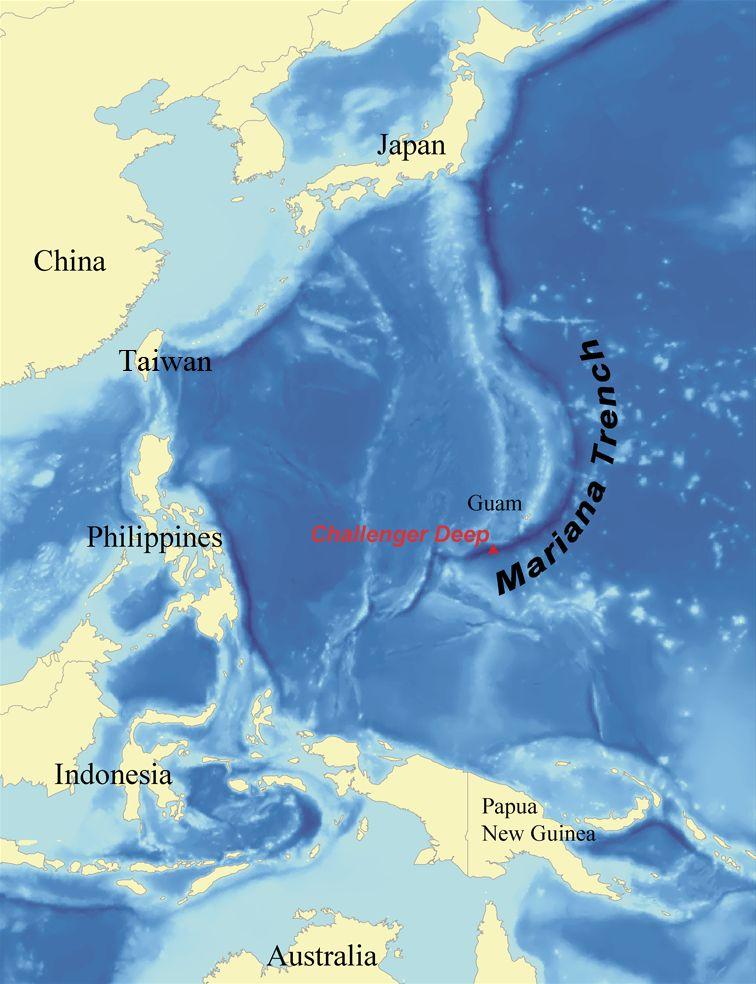
The Mariana Trench is located in the western Pacific Ocean, about 200 km east of the Mariana Islands, with its deepest point being 11,050 meters in a small valley at its bottom, the Challenger Deep. However, the sea snail is not the only living being that has adapted to survive under such extreme conditions: over a thousand atmospheres of pressure, four degrees Celsius temperature, and total darkness.
The trench is also known for harboring beings that seem from another world. For example, a giant squid of the species Architeuthis (which can reach up to 14 meters) has been found there, in addition to numerous unknown species of fish. Most fish that inhabit such depths have a soft, gelatinous, and scale-less structure, allowing them to withstand the high pressure.
The closer to the surface, one can find more life forms such as bioluminescent jellyfish that provide the only light in that immense darkness, the lanternfish with its organs visible due to its transparent body, the goblin shark with its elongated nose, or the eel-like shark with its 300 sharp three-pronged teeth.
And yes, these animals look as fearsome as they seem, including the carnivorous Anoplogaster and the frightening viperfish, fish that appear to be taken from the worst nightmares. Ironically, at the maximum depth, the largest creatures that can be found are only amphipods, small shrimp-like crustaceans.