
The Genetic Advantages of the Bajau

Throughout history, a country has been associated with a piece of land. The RAE (Royal Spanish Language Academy) describes it this way: "Territory, with its own geographical and cultural characteristics, which can constitute a political entity within a state." Therefore, it is not crazy to think that a landless country is something that could only exist in science fiction or fantasy stories. But there is a tribe that finds its home in water.
This is the Bajau tribe, better known as 'sea nomads', and they live in floating houses or coastal villages. Their existence has been known since the 16th century, when the Venetian Antonio Pigafetta highlighted in his book 'Primo Viaggio Intorno al Globo Terracqueo' the extraordinary diving abilities of the Bajau. This ethnic group, formed by about a million people, is found between the Philippines, Malaysia, and Indonesia, but due to their aquatic lifestyle, they have no nationality.
A Lifestyle at Risk of Extinction
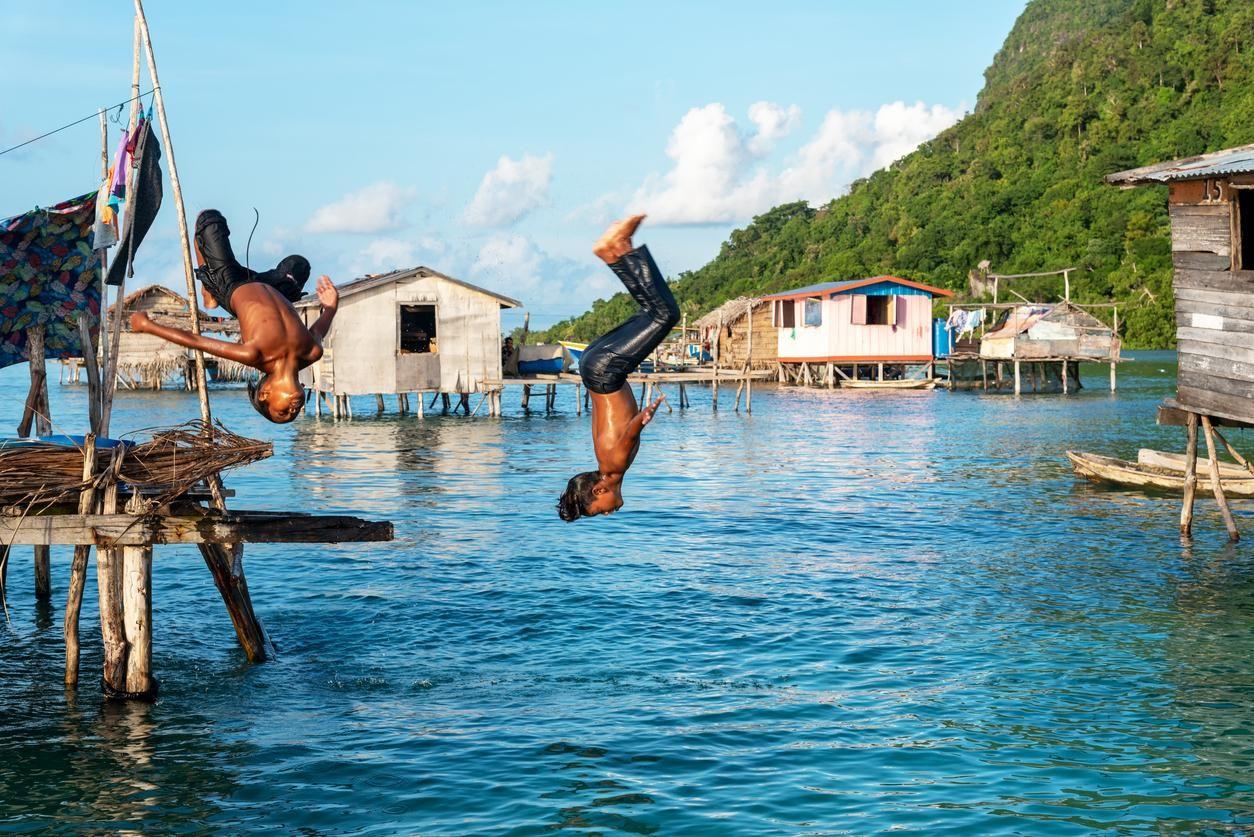
They are also referred to as 'gypsies of the sea', as they have been involved in trading maritime products for centuries. By the age of three, they learn to dive, and their knowledge of the sea is so extensive that in 2004, they survived a tsunami that claimed the lives of 260,000 people. But their uniqueness goes far beyond that. They exhibit some genetic traits that lead many to believe they are a type of superhuman.
They can dive up to 70 meters deep and hold their breath for 13 minutes. Altogether, they spend more than 60% of the day submerged. Their bodies are prepared for this, which is not just due to rigorous training. Among the features that scientists highlight is the mutation of their spleen, the organ responsible for maintaining the immune system and recycling red blood cells. In the Bajau, the spleen has grown 50% compared to tribes like the Saluan.
Additionally, their eyes are different and adapted to prevent cloudiness underwater, unlike others. Their ears are also somewhat prepared to manage pressure when diving to such depths. While the older generations wish to continue living in the most traditional manner, it is increasingly difficult to maintain it: the reef habitats where they usually dive are depleting their resources.
A Lifestyle at Risk of Extinction

For the 'sea nomads', this represents a genetic advantage that could be compared to that developed by other communities living in extreme places on Earth. Something similar occurs with Peruvian highlanders who live at extremely high altitudes, working and moving without noticing tiredness. This is due to their having developed larger lung volume than other humans. In short, they can breathe more air, something fundamental in mountainous areas.
Although this lifestyle is currently endangered, each member seeks to preserve something so special. In fact, when any of them are offered to move to a land community, they refuse to stay with their own and preserve their traditions. This tribe is also a great example of how recent human evolution works, making it a key point for researching humanity and learning more about its past.