
The Seven Most Beautiful Hispano-Muslim Monuments


Eight centuries of Hispano-Muslim history in Spain brought forth a wealth of cultural heritage.
Many of the most important monuments in our historical and artistic patrimony date from that period. Here are seven examples that you cannot miss for anything in the world.
The Alhambra of Granada
It was the last great example of Andalusian architecture in Spain. A flash, a final pearl, the last twinkle before the disappearance of the most valuable star in the sky. The Alhambra of Granada encapsulates the eight centuries of Hispano-Muslim rule on the Iberian Peninsula.
It was commissioned by King Alhamar of Arjona, the founder of the Nasrid dynasty that governed it for two hundred forty years, before the entry of the Catholic Monarchs into the city. Broadly speaking, the Alhambra is divided into three significant heritage areas: the Alcazaba, the Royal Palaces of Comares and Lions, and the Generalife. The arrival of Christianity in the city brought about new changes, the most significant being the construction of the palace of Emperor Charles V.
The Royal Alcázar of Seville
Seville is home to dozens of heritage examples from the Hispano-Muslim period. The Giralda is one such example, serving as an Almohad minaret.
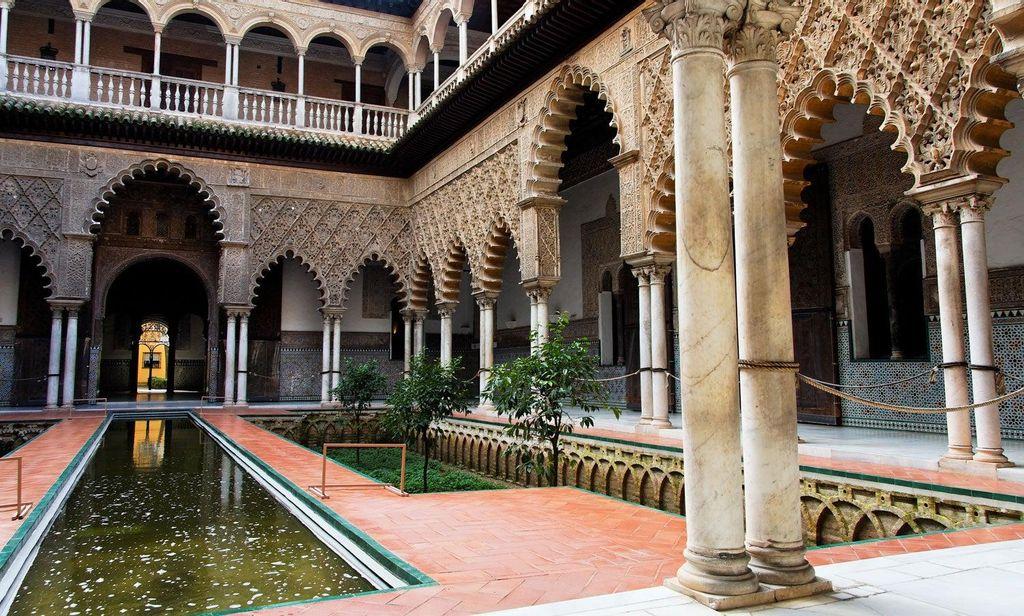
But the Royal Alcázar summarizes much of the Hispano-Muslim spirit in the Andalusian capital. Most of its construction occurred during the Christian period, but the decoration of its main palaces and courtyards evokes the best of Andalusian architecture. Additionally, Seville has dozens of churches built on ancient mosques converted to Christianity when Ferdinand III conquered the city.
The Mosque of Córdoba
It is the pinnacle of Hispano-Muslim heritage on the peninsula. The Mosque of Córdoba was commissioned by the first Umayyad emir on the site of the Visigothic church of San Vicente. Its heirs later expanded it over different periods until its colossal dimensions were completed. The Christian conquest altered the original plan of the building with the construction of a cathedral in its center. Nonetheless, its presence undoubtedly contributed to the preservation of this monument in all its integrity. The double height of the arches and their white and red tones symbolize the value of one of the most important monuments in the history of art of all time.
The Arab Baths of Jaén
They are the largest and best-preserved Arab baths in Spain. They are located in the basement of the Palace of Villardompardo, commissioned in the 16th century by Fernando de Torres y Portugal, viceroy of Peru.
The baths date back to the caliphate period and their builders utilized the remains of an ancient Roman bath. Their recovery began in the 20th century, but it wasn't until 1970 that architect Luis Berges Roldán started the restoration work that earned the Europe Nostra Award.
The Alcazaba of Málaga
Much of the Andalusian constructions were built over long-lost Roman buildings. The Alcazaba of Málaga is one such case, which can boast of having been a Phoenician trading city before the arrival of those legions. The Alcazaba overlooks the port and gazes out from the slopes of Gibralfaro over the bustling city where Picasso was born. From the towers and walkways of the Alcazaba, one can see the bay and the Málaga Mountains. Its interior is presided over by the Cuarto de Granada, the most sumptuous heritage area from the Nasrid period.
The Alfajería of Zaragoza
It is one of the most sumptuous palaces of Andalusian art. It was built in the second half of the 11th century by order of King al-Muqtadir of the Hudid dynasty of Zaragoza. The Alfajería is the most vibrant example of the art from the taifa kingdoms of the peninsula, just before the arrival of the Almoravids. Inside, the beauty of its multi-arched structures and rich use of decorative details stand out. When Alfonso I, known as the Battler, conquered Zaragoza in 1118, the Alfajería became the royal palace and a principal center for the diffusion of Mudéjar art.
The Mosques of Toledo
Toledo is one of the Spanish cities with the most Hispano-Muslim monuments. Within its rich heritage, the mosques of Christ of Light and of Tornerías stand out. The first is located on the northern side of the city, near the Valmardón gate. Its layout is square, and when Toledo was conquered by King Alfonso VI in 1085, the temple was consecrated to Christianity under the invocation of Christ of Light. The other prominent mosque in Toledo is Tornerías, also constructed in the mid-11th century on the remains of Roman buildings, in what is known as the Arrabal de los Francos.