
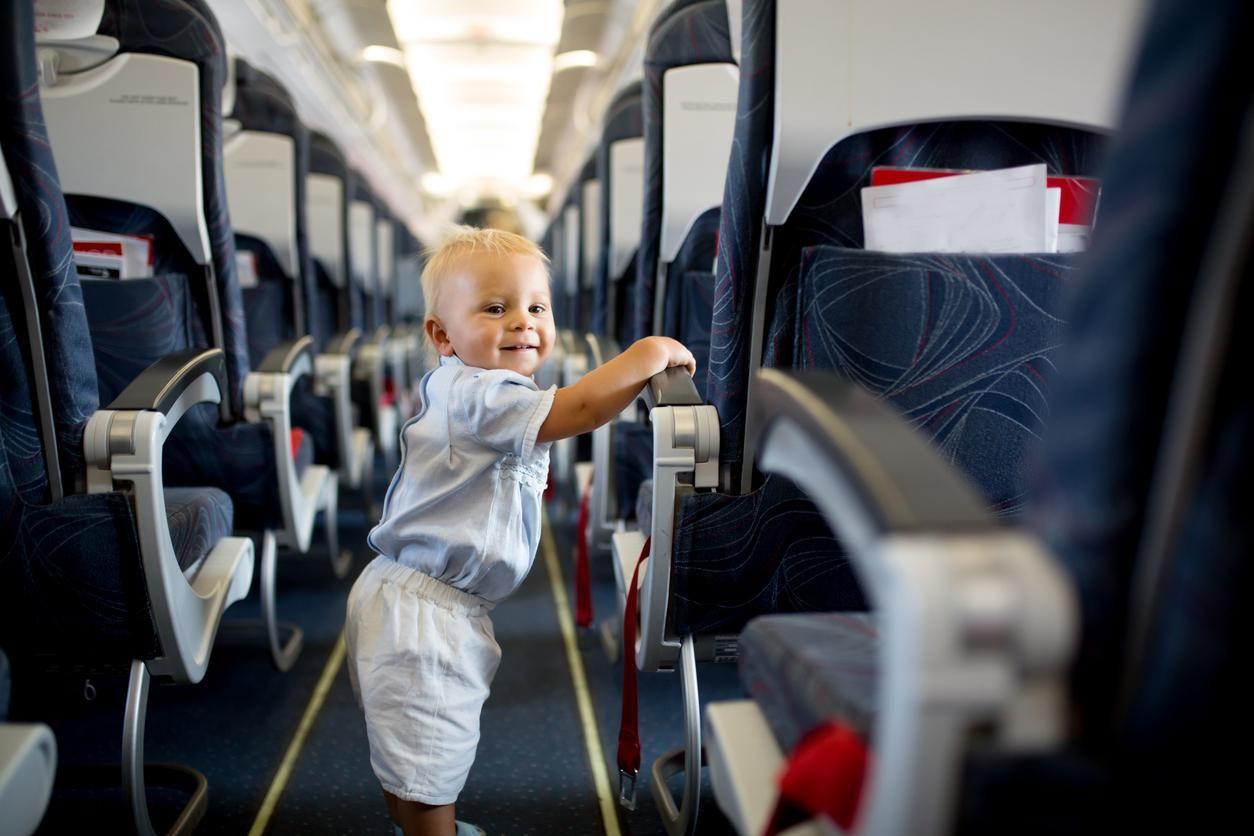

A few people in the world have the privilege of experiencing their first moments on Earth through an airplane window, gazing at the sky above the clouds. Although they may not remember it, it's surely a story they never tire of telling: "I was born on a plane". On rare occasions, airplanes land with one more person on board than when they took off. Flying while pregnant is a choice that doesn't have to pose any issues, as long as the woman adheres to the guidelines set by the International Air Transport Association (IATA).
The recommendation is not to fly after the 36th week of pregnancy -32 weeks for multiples-. Moreover, if she is between 28 and 35 weeks pregnant, she must present express authorization from her doctor. Nevertheless, there are exceptions, and at least 75 people have given birth at more than 12,000 meters in the air, always prematurely. The airlines acknowledge the slim possibility of this happening, and there is usually no problem with the delivery. The question often arises regarding the nationality of the newborn, but it is really quite simple. They can either be subject to the right of the land -where they are born- or the right of blood -through the nationality of the parents-.
Sometimes, when the nationality of the parents or the territory in which they are born is not granted and the baby becomes stateless, the origin of the airline appears on their passport. The United States, for its part, grants nationality to any child born on a plane flying over its territory or airspace. The first girl to be born in the air was Airleen in 1929 - although it was believed that the first was in 1947-. Her father was a doctor who loved airplanes and, when he saw that his wife was very far along in her pregnancy, they boarded a plane and flew around the sky until she gave birth.
When the airplane becomes a delivery room
This curious story was discovered by Shona Kirsty Yves (by her initials SKY), another woman born during a mid-flight delivery in 1990. In her case, her mother boarded a plane in Ghana to reach Scotland where she was expecting to give birth to her second daughter. She had seven weeks left before her due date, and the doctor had confirmed she could board. The little girl decided to arrive early, much to the astonishment of her mother and her four-year-old sister. Her father, who planned to stay in Africa a few more days before the birth, learned from a call from the pilot: "This is the British Airways pilot speaking, your wife has gone into labor."
As they approached Paris, she stopped fighting against the forces of nature that demanded to expel the baby, and finally, she ended up giving birth "somewhere over the English Channel". She has a passport that does not indicate a country of birth, but rather states "born at sea" and the airline continues to have special arrangements with her. However, not all 'skyborns' (as they are called in Spanish) enjoy such benefits. In 1995, another girl was born in the air and the airline granted her a scholarship and flying privileges; while in 2015, another girl received free tickets until the age of 18. However, some companies have stated they are unwilling to offer any of these perks.
What many of these newborns do have in common is that their names are related to the sky, such as Airleen and SKY, or they even adopt the name of some crew member who played a significant role during the delivery. Being born mid-flight is not the safest for either the mother or the baby, as the air is lighter and it is more complicated for the newborn to breathe; hence, a small percentage does not survive. Moreover, it is not common to make an emergency landing nor to consider transferring the passenger to a hospital, as that would take too much time and money for the airline. What is certain is that 'skyborns' are born to travel.