

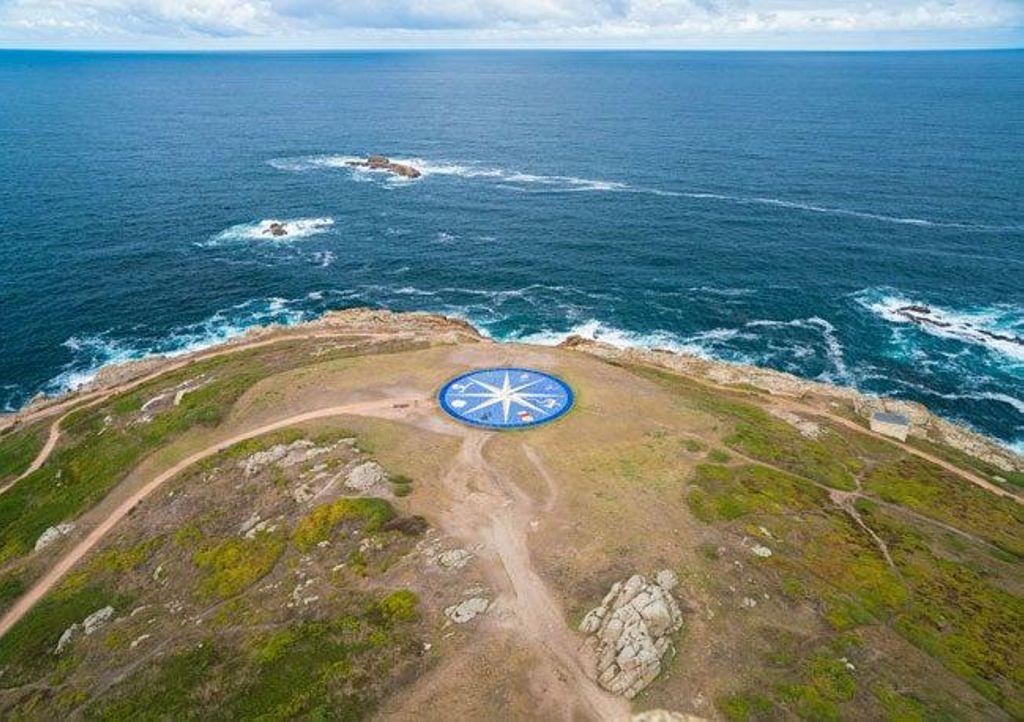

A Rose of the Winds was commissioned to the artist Correa Corredoira, one of the leading exponents of contemporary Galician art, twenty-two years ago. At that time, the authorities wanted to revive the previously forgotten area around the Tower of Hercules and turned to various Galician artists to develop several projects for the beautifully wild area around the lighthouse, battered by the sea.
Correa was tasked with creating his project on an old quarry at the foot of the Tower. Initially, they asked him to create a mural. He wasn't entirely convinced by the idea, and after much thought, the possibility of making a square under the gaze of the lighthouse, also looking north, came to his mind. Thus, A Rose of the Winds was born, representing the Celtic mythology of the North Atlantic. In it, through the eight quadrants it is divided into, the Celtic countries are represented: Galicia, Scotland, Wales, Cornwall, the Isle of Man, Ireland, and Brittany.
It soon became a symbol of A Coruña as Correa Corredoira himself explains: "A Rose of the Winds has slowly become one of the city's emblems over the years. It appears in tourism brochures, on postcards, it has been on television... it has even been the setting for a movie."
From A Coruña to Namibia

Until one day, twenty-something years later, the artist received a call from the director of the Tower of Hercules. Someone from Namibia who had seen A Rose of the Winds was fascinated and wanted a replica in the African country. That "someone" was Angel Tordesillas, who had been a manager of Pescanova in Namibia and was still connected to the African country by completing specific projects. One of those projects was the construction of a Maritime Museum in a restored power plant in the city of Lüderitz, Namibia. A square like A Rose of the Winds was just what was needed for the waterfront bordering the museum.
The South Rose
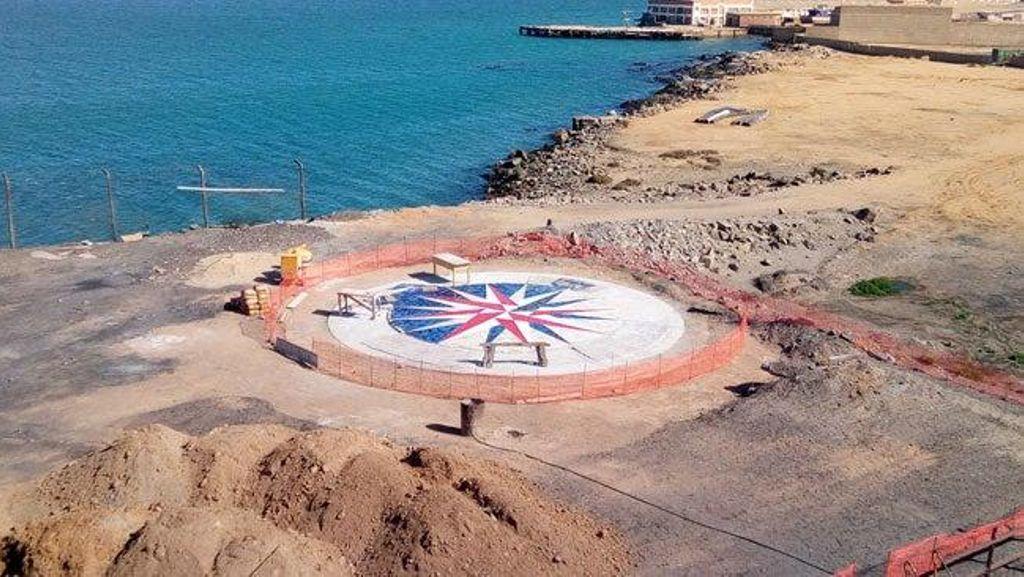


The South Rose stands in a setting very similar to that of A Coruña, on a sort of terrace or platform above the sea. It is smaller than its Galician 'sister', measuring about 12 meters in diameter compared to 20 for its A Coruña cousin and is divided into quadrants with different Namibian motifs: the oryx, the desert antelopes, the welwitschia mirabilis, one of the symbols of the country that draws water from the mist coming from the sea...but above all the artist wanted to represent the meeting between desert and sea, this spectacle and miracle of nature.
Months after that first trip to Namibia and working on the projects for the South Rose in his workshop in the Galician village of Vilar de Locrendes, Correa traveled again to the country to begin constructing the square. Under his command were ten bricklayer apprentices divided into groups who worked alongside him tirelessly. Correa relied on his partner, Celia, to communicate with them in English. The experience was challenging but equally enriching: "Some only spoke the local language, but even so, they cried when I said goodbye. It was 40 days of nonstop work," he states.
The technique and materials used in Namibia were the same as in A Coruña; mosaic made from vitroceramic pavement cooked at over a thousand degrees to increase its hardness. Tono himself explains how the process of creating this South Rose was: "When the drawings are simpler or linear, I painted on the same platform, cut the ceramic pieces, and filled them on the surface of the plate (the concrete slab used as the base). If the drawings were more complex and detailed, I painted them first on large panels, and using the panels as examples, the tiles were cut. Once cut, they were placed one by one on the concrete floor and assembled like a puzzle. The ceramic pieces adhere with glue. Once the mosaic is finished, the last step is to 'grout', pouring a liquid cement paste into the cracks to help set the whole piece," explains the artist.
It seems, from what Correa explains, that the Namibia experience has left a mark on his life and will undoubtedly leave a trace in his work, just as all his travels do. Although 'sisters', the two Roses have nothing in common. Tono managed to square the circle, the most difficult challenge: to do the same without repeating, each square with its own reason for being and its identity, one looking North, the other South. Few have the fortune to leave their mark in such diverse and remote places in the world. Perhaps the South Rose will be, in a few years, one of the symbols of Namibia.