
The Myths Surrounding the Tallest Mountains in the World: Truth or Fiction?


Mountains, majestic yet enigmatic, have captivated and surprised humanity since ancient times. Ancient civilizations believed that these immense masses of stone were much more than natural geological formations and that they were divine. Legends and tales of gods and mythical creatures revolve around these mountains and continue to fascinate those who discover them today.
The supernatural and the ancestral are present in the history of some of the peaks over 8,000 meters, yet some of these mysteries have explanations and completely differ from reality. Others remain a mystery for many, but it is left to each individual to decide whether the myths and legends of the tallest mountains in the world are false or true.
Dhaulagiri I and the Yeti
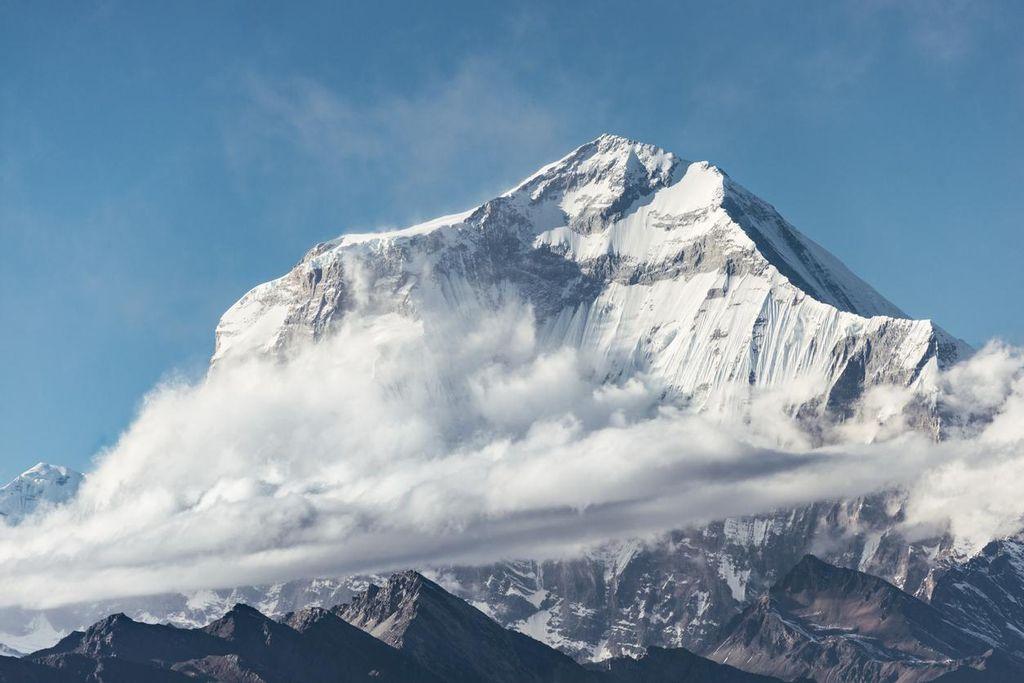

Dhaulagiri I, in the Himalayas, is the highest peak of the Dhaulagiri massif, reaching 8,167 meters in height. It is the seventh highest mountain on the planet and is part of the 14 eight-thousanders. Its fame comes from the extreme danger associated with reaching its summit, making even the most prepared climbers face extreme challenges.
But its imposing size and great danger are not the only elements that have made the mountain famous. Within its icy paths lives a legend that attracts the curious and is hard for many to believe. A group of Japanese explorers claimed to have found footprints of the legendary Yeti, a world-famous creature whose existence has not been proven.
These adventurers decided to spend weeks on the mountain on expeditions dedicated to discovering to whom or what these mysterious footprints belonged. The footprints found were approximately 20 centimeters long, a size very similar to that of humans, but that possibility was dismissed due to the extreme remoteness of the location.
The legend persists over time, and some climbers, like the British Hodgson, claim to have seen a large creature with dark hair and two legs walking in the area. Furthermore, many mountaineers confirm having found these footprints belonging to an unknown creature. The truth is that the existence of the Yeti has not been scientifically proven, so for now, it will remain a legend.
The Cemetery of Everest


Everest is possibly the most famous mountain on our planet, as well as the highest. Its 8,848 meters have been the dream of many climbers who aspire to reach the summit where they can almost touch the sky. Unfortunately, fame goes hand in hand with danger, and every year, some of the adventurers aiming for the summit lose their lives.
There is a myth that says there have been over 200 deaths on Everest, and unfortunately, that is true. Most of the bodies of climbers cannot be recovered and remain accumulated on the mountain in an area known as the Rainbow Valley. This name comes from the line of colorful-clad corpses typically worn by mountaineers found throughout Everest.
This section is extremely dangerous and is located on the north side of Everest, beginning after surpassing 7,920 meters. This area is known as the Death Zone and is where most climbers lose their lives. Here, the oxygen levels drop to nearly unbreathable and complicate climbing. Beyond this level, the recovery of bodies is nearly impossible due to the high economic costs and the danger posed to rescue teams.
Additionally, due to the low oxygen levels, another myth associated with Everest arises regarding ghost sightings. This myth has been debunked by experts who assert that these sightings are linked to the lack of oxygen in the brain, which causes hallucinations in climbers.
K2 and the Curse of Women

Another renowned mountain that appears on the list of the tallest in the world is K2. This imposing massif is also known as Qogir and Kechu and is located in Pakistan, also in the Himalayas. Its height of 8,611 meters has made it the second highest mountain in the world.
However, like the rest of its companions, its dangerous pyramid shape and the slopes that form it have also made it one of the most dangerous mountains in the world. Numerous climbers have lost their lives on K2, but there is a specific group of people who have suffered greatly in trying to reach the summit.
There is a myth that claims that every woman who attempts to climb K2 ends up losing her life. For many years, all women who tried to reach the summit perished, but not while attempting to climb, instead during the descent or shortly after. From this tragedy, which took the lives of several women, the legend of the curse of women and K2 arose.
Fortunately, in 2004, it was proven that this legend was false, and it was a Spanish woman who did it. Climber Edurne Pasaban defied fate and became the first woman to climb K2 and live to tell the tale. Since then, hundreds of climbers and female mountaineers have reached the summit and returned alive, so the legend remains just a myth.