
The 8 Most Mysterious and Terrifying Places on the Planet
The world is a place full of mysteries and iconic places that never cease to amaze us. Among the thousands of tourist destinations and attractions around, eight stand out above the rest. Haunted places that cannot be visited at night, bridges that no one dares to cross, or strange phenomena that create unprecedented situations. In this article, we compile the 8 most mysterious places in the world.
Devil's Bridge

Located in Kromlauer Park in Germany, Devil's Bridge reflects on the water, creating a perfect circle, which some believe to be the work of the devil himself. However, this is not its only curiosity, as its greatest feature is that it does not allow crossing. Experts claim that its construction is so fragile that any minimal alteration could cause it to collapse. In fact, they assert that it was built solely for aesthetic purposes.
It was erected in 1860 with stones from the area and adorned at its ends with rock needles. It owes its name to the fact that its construction is as perfect as it is dangerous and miraculous, which is why many believe that its construction would not have been possible without the help of Satan.
Skeleton Lake

Located in Uttarakhand, India, Skeleton Lake gained fame in 1942 when a ranger discovered hundreds of human bodies frozen in its waters. Despite the uproar, authorities have classified it as a mystery, with barely any investigation into what might have happened. During the colder months, the water freezes and expands, hiding such a macabre sight. When warmth arrives and the ice melts, the remains of unknown origin are once again visible. It is estimated that there are between 600 and 800 skeletons in the area.
The most widespread theory is that all the remains belong to a group of people who were victims of an epidemic, an avalanche, or a storm that occurred between the 12th and 14th centuries. However, experts say that the bones belong to people of different ethnicities and parts of the world. Recent studies claim that the oldest skeletons date back to the year 800, while the most recent ones are from 1800. Therefore, they consider that the majority did not die directly in the lake but ended up there for unknown reasons.
Snake Island

Its real name is Queimada Grande Island, but everyone knows it as Snake Island, located off the coast of Sao Paulo, Brazil. Its popularity comes from being one of the most dangerous places in the world, housing some of the deadliest snake species on the planet. In fact, the risk of setting foot on the island is so high that access is entirely forbidden. Only scientists or researchers who obtain special government permission are allowed to land on it.
Its main inhabitant is the Bothrops insularis, a yellow-brown snake that does not exceed 70 centimeters in length. But do not be deceived by its modest size; with a single bite, it can melt the skin of the person it attacks. Its lethality is a result of evolution. About 11,000 years ago, this area was isolated from the mainland, becoming an island. As a result, the venom of this species became much deadlier to easily take down large prey and ensure its survival.
Growing Stones in Romania
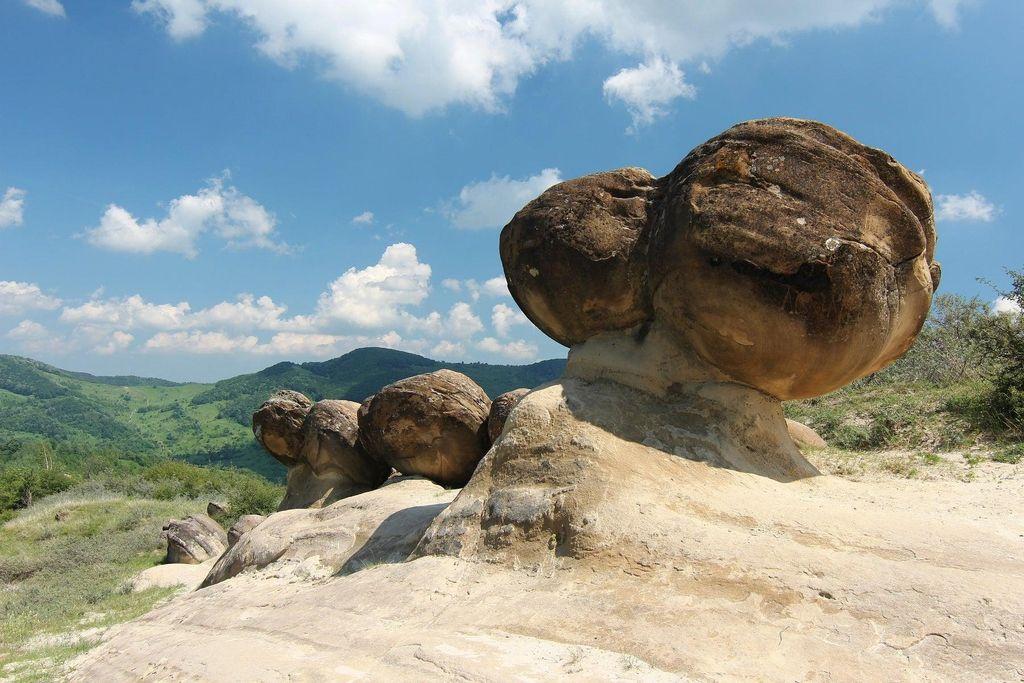
It is said that stones are an inanimate element, but in Costesti, Romania, there is a phenomenon that challenges this claim and causes the stones to grow. However, if you expect to see them gain height during your visit, you can forget that idea. According to experts who have studied the area, these peculiar stones are about 6 million years old and started as small pebbles in the ground. Some of these small formations are now large stones that reach 10 meters in height. It is estimated that they gain 4 or 5 centimeters every thousand years.
Studies conducted to determine their growth have concluded that they function like a tree trunk, adding layers to grow. The accumulation of carbonates inside causes them to rise towards the sky when rainwater exerts pressure on the ground. These stones have captivated the world so much that UNESCO declared them a World Heritage Site.
Bhangarh Fort

Between Jaipur and Delhi lies the most haunted place in India, Bhangarh Fort. Access between sunset and sunrise is completely prohibited, as indicated by a sign in the access area: "Entering the borders of Bhangarh before dawn and after sunset is strictly forbidden. Legal action will be taken against anyone who does not follow these instructions." The significance of this warning is such that it is the only place in the country that the Government of India has legally recognized as haunted.
Its legend states that it was cursed by Guru Balu Nath, who allowed the city's construction under the sole condition that nothing would ever cast a shadow over his home. A young prince, disobeying this ordinance, built a huge palace that cast a shadow over his house, prompting him to curse the town. Another legend states that a sorcerer fell in love with the princess of Bhangarh and tried to sell her a magical oil that would make her fall in love with him. She realized his intention and spilled it on the ground, causing a massive rock to emerge from the earth and crush the sorcerer, who managed to curse the town beforehand.
North Sentinel Island

We continue in India to travel to North Sentinel Island, the place where a tribe lives isolated from the world and is one of the most dangerous known. Its inhabitants were unaware of fire until just a few years ago, do not practice agriculture, and survive off foods provided by nature, hunting, and fishing. These last activities are carried out with very rudimentary tools. They live almost naked and speak a language unintelligible to the rest of humanity.
The government attempted to census them for the last time in 2001 without much success, as they only managed to spot 21 men and 18 women. However, it is estimated that there may be about 500 indigenous people in total. Their existence dates back 70,000 years, and they continue to live the same prehistoric way of life. Due to their rejection of the outside world, Indian authorities do not apply their legislation on this island, although it is within their territory. The indigenous people attack anyone who crosses their border, and the government warns that it will not be responsible for any deaths they may cause.
Nazca Lines

In the heart of the Nazca Desert, in the Pampas de Junama, Peru, there are more than 10,000 lines about 30 meters wide and over 9 km long that form shapes when viewed from the sky. These mysterious lines were discovered in 1547, and numerous theories have been proposed about their curious shapes: roads for travel, a giant astronomical calendar, a landing strip for UFOs, or a irrigation system. However, although some got close, none were correct.
The Spanish Carlos E. Hermida was the one who solved the mystery by determining that "the Nazca Lines are a gigantic hydraulic engineering system, a complex system of artificial irrigation lines, a pre-Incan technique known as water harvesting, which turned the desert into a green zone, visible from the sky, a system applicable in today's world." The goal was to transform an arid area like the desert into a giant agricultural field.
Blood Falls
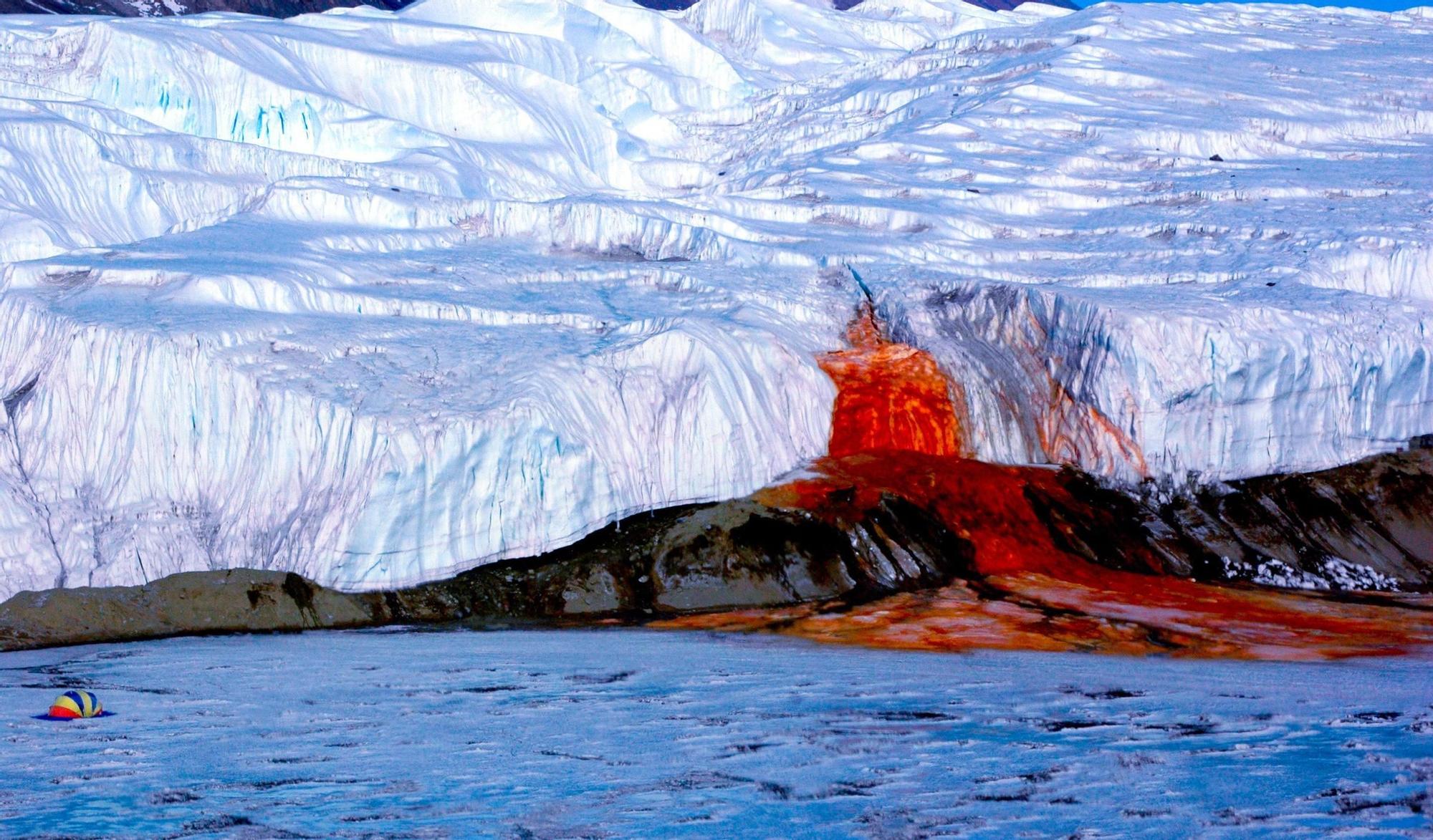
Antarctica is one of the most uninhabited places on Earth and therefore one of the places that can hide the most secrets. In 1911, a geologist discovered a waterfall emerging from the ice, emitting a viscous mass of a very vivid reddish color. This phenomenon earned it the name Blood Falls. Its discovery led to it becoming one of the most researched places on the planet.
At first, it was thought that its peculiar color was due to some algae in the area that dyed the water that reddish hue. In 2017, the true origin of this phenomenon was discovered. Beneath the glacier itself, there exists a natural spring with a large accumulation of iron particles. These, when mixed with the water, cause oxidation that turns it a reddish color due to its high iron content.