
The Glass Route: A Plan to Explore Spain Following an Ancient Art

From Granada to Málaga, passing through Cartagena, Valencia, Gordiola, Girona, Barcelona, and La Granja de San Ildefonso... These are some of the locations, around 30 towns, that have united for their glassmaking traditions and created a new route, the Glass Route. With this material as the protagonist, the proposal covers archaeological sites, museums that honor the art of glassblowing, small craft workshops, and architectural gems. The technique of glassblowing was recognized in 2021 as a Representative Manifestation of Intangible Cultural Heritage in Spain.

The initiative, launched by Ecovidrio, the CSIC, ANAREVI (National Association of Glass Recycling) and ANFEVI (Association of Glass Container Manufacturers), aligns with the celebration in 2022 of the International Year of Glass, declared by the UN. This year celebrates the importance of glass in many areas, from the aerospace and automotive sectors to architecture, the arts, information technology and communications, energy, healthcare, laboratory work, optics, packaging, and storage. Furthermore, glass can serve as an alternative to plastics and other materials and has the potential to contribute to the implementation of sustainable production and consumption guidelines.
Here are the different proposals of the route according to the territory:
1. Route through Southern Spain

When the Romans arrived on the peninsula, they created the Vía de la Plata, a road that crossed the territory from south to north. It began in Asturica Augusta (Astorga) and ended in Augusta Emerita, or as we now know it, Mérida.
The remains we have from their passage through the city of Badajoz are some of the most important in our country, which is why the National Museum of Roman Art was founded there. It includes remains from four glass factories that have preserved a large collection of tableware and artistic pieces made of glass from the 1st and 2nd centuries AD.

A few centuries later, we find in our history the glass factory established by Hernando de Zafra in Castril, Granada. The glassmaking tradition in this locality dates back to the Arab period, but in 1504 the first factory was established by this Extremaduran, who, after a trip to Barcelona, decided to set up a factory in the area with the knowledge he acquired there. This became the most important glass center in Andalusia. Nowadays, Spain holds an exquisite collection at the Archaeological and Ethnological Museum of Granada.
Moving towards the Mediterranean, along the Costa del Sol, we find the Museum of Glass and Crystal in Málaga, a restored 18th-century mansion that houses around 3,000 pieces from various periods (stained glass, vases, or containers), inviting visitors to explore the history of humanity through glass.
2. Route through Eastern Spain
The Levantine coast offers the most extensive cultural itinerary within the glassmaking tradition. The route may begin in Cartagena, where an important glass and crystal factory was established in the 19th century, and whose legacy survives today in the Santa Lucía Glass Museum, which serves as a demonstration space and training center. Its mission is to recover and disseminate the history of glass in the city, as well as to promote appreciation for this material and encourage artistic production with it.
In the province of Valencia, we find the Phoenician imprint, particularly at the La Covalta archaeological site in Albaida, an ancient Iberian settlement inhabited from the 6th century BC to the 3rd century BC. The pieces found there belonged to the upper class of the society that made up the settlement. Beads, seals, colorful pendants, small bottles, and other types of containers were discovered at this site and are now on display at the Museum of Prehistory of Valencia.
Excavations at the Visigoth settlement in València la Vella, in Ribarroja de Túria, have uncovered a glass production center, metalworking furnaces, and an area of houses, demonstrating that it was a very important production center around the 6th century. Travelers can visit the Visigoth sites by contacting the Tourism Office.
This route ends in Valencia, where visitors can explore the Archaeological Center of l'Almoina, which features a Visigoth burial that includes various valuable objects, among them, some made with blown glass, demonstrating the existence of this technique in the city during the Middle Ages and which continues to this day. Currently, the Levantine capital boasts prestigious artist workshops where unique pieces can be acquired.
3. Route through Mallorca

Glass arrived on the Balearic coast through the Phoenicians in the 2nd century BC. This trading people established the first glass furnaces on the islands. Local artists created various forms similar to pottery and later the first stained glass. During the 16th and 17th centuries, glass from Venice arrived in Mallorca through glassmakers from Murano, who taught local artisans their techniques and materials to begin creating their own products. Thanks to this legacy, Mallorca is the island with the greatest glass tradition.
Gordiola, in Algaida (Mallorca), is the most important glassblowing and craftsmanship factory on the island, founded in the 18th century and for more than 300 years and eight generations has been creating unique pieces. Visiting it is one of the classic plans on the island, to the extent that during the peak tourist season in Mallorca, kings from across Europe, authorities, politicians, and even famous artists were almost obligated to visit the facilities to observe firsthand the meticulous artisan process of glassblowing at very high temperatures.
In Palma, we find the Fiol Artistic Glass, which has been manufacturing and restoring leaded stained glass since 1964. In their store, one can also purchase Tiffany-style pieces and they were responsible for restoring several windows of the Cathedral of Palma and the stained glass and skylight of the Parliament of the Balearic Islands.
Lafiore Artistic Glass, in Esporles, produces handcrafted objects, among which the Mallorcan oil bottles stand out, as well as other products like bottles, glasses, wine decanters, jugs, or lamps, among others. All of them are made with 100% recycled glass, so the buyer is also contributing to environmental conservation.
At the Museum of History of Manacor, one can see glass objects from the post-Talayotic period, between the 6th and 1st centuries BC, when the first pieces of necklaces made with brightly colored glass paste appeared. Here, one can also admire glass lamps discovered in 1912 when the Son Peretó site was unearthed, which featured a paleochristian basilica and its baptistery, as well as an important collection of mosaics and other archaeological materials.
4. Route through Catalonia

The tradition that runs along the entire east coast of Spain culminates in Catalonia. In this community, glass played a prominent role to the extent of being included in the names of certain municipalities, such as Vidreres, which means "to work glass" or "source of glass."
In Girona, there are many museums and monuments that preserve stained glass of great value to the city. This material adorns buildings and private homes, placing Rafael Masó as one of the most important architects of the time. In fact, his own house is a symbol of the development of the Novecentismo movement and is open for visitors. Additionally, the Cathedral of Santa Maria in Girona is another key monument that features stained glass from various origins.
We cannot overlook the glass treasures that the streets of Barcelona safeguard. The Catalan city boasts historically significant buildings of high tourist interest such as the Palau de la Música, or well-known architects like Antoni Gaudí, creator of the Casa Batlló. Regarding religious buildings, the Sagrada Familia is characterized by the stained glass that Gaudí designed, and in the Cathedral of Barcelona one can admire Gothic and 20th-century stained glass.
In Vimbodí i Poblet, the first documented glass furnace dates back to the 2nd century. There, you can visit the Glass Museum and Furnace, which is the only museum in Catalonia dedicated specifically to the tradition of glass, and where you can enjoy live glassblowing demonstrations and an exhibition space. If the visit is made in October, travelers can enjoy Vitrum, the festival of artisan glass of Catalonia.
5. Route through Castilla and León

This route begins at the Royal Glass Factory of La Granja, located in the Royal Site of San Ildefonso. This factory, built with the arrival of the Bourbons to Spain in 1727, did not reach its full glory until the reigns of Charles III and Charles IV when it competed with factories throughout Europe thanks to the most advanced technological means on the continent.
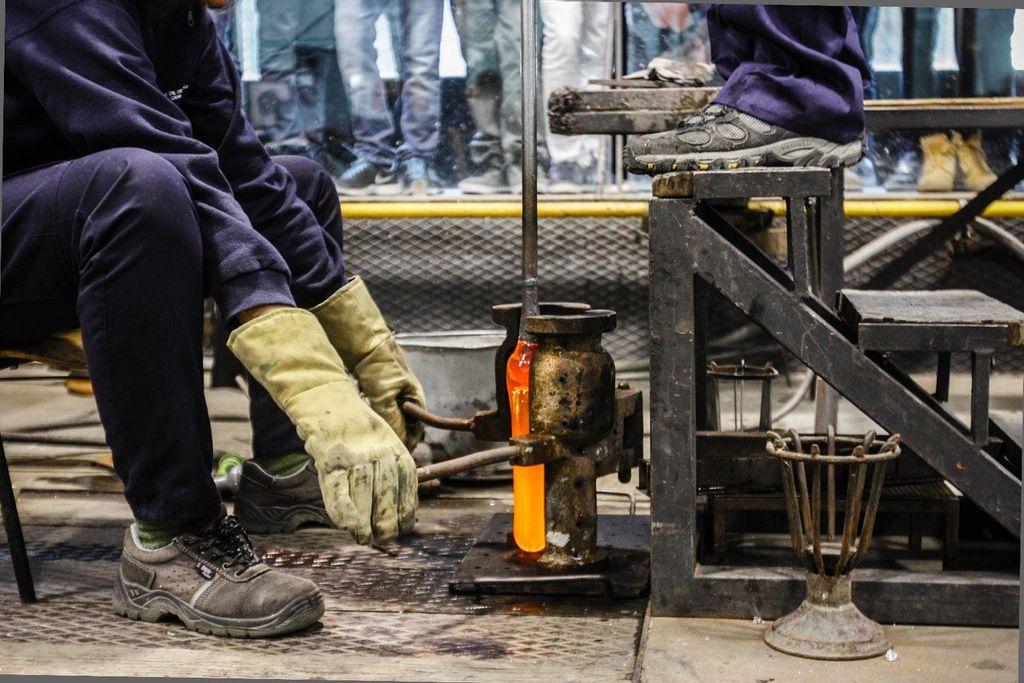
Here, the art of glassblowing has been preserved to this day, and a visit allows for an understanding of the heart of this complex, a collection of over 700 pieces of various kinds, as well as the work that the master artisans continue to do to keep this factory alive.

For those wishing to visit the capitals of Burgos and León, cities closely linked to the recycling and manufacture of glass containers, it is important to highlight the presence of medieval stained glass in both cathedrals.