

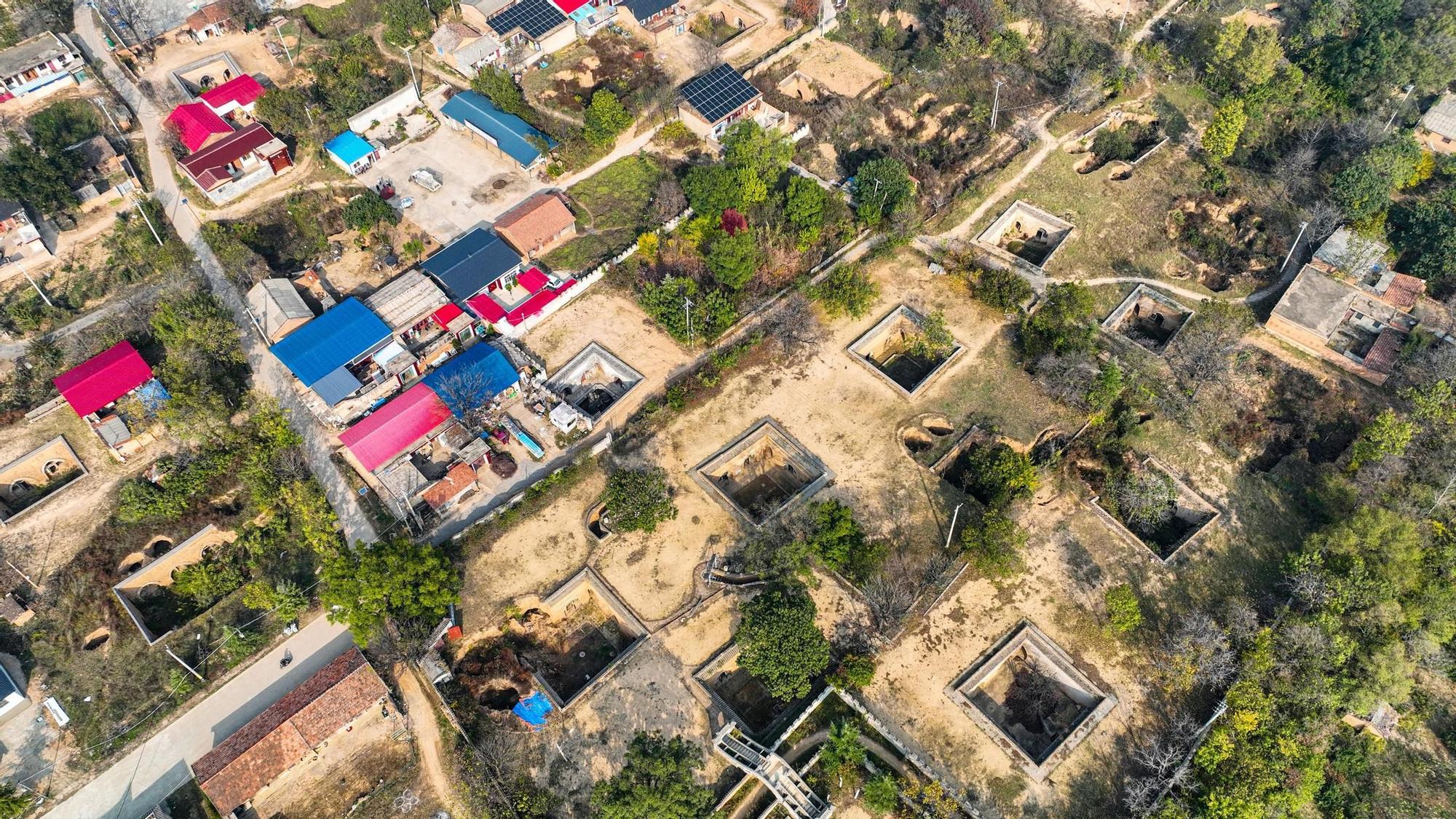
With over 94 million inhabitants, Henan remains today as one of the most populous provinces in China, surpassed only by Guangdong and Shandong, both located on the coast, making it the most populated area in the interior of the country. It is also one of the oldest places, with four ancient capitals within its perimeter; it is said that Chinese civilization began in these lands over 4,000 years ago.
As one of the true origins of the Chinese nation, it has been the protagonist in a history full of periods of splendor, subsequent declines, and falls. Due to its geography and historical significance, it has been involved in most of the major wars in Chinese history. This is why the village of Dikeng could be considered a rarity, as amidst everything, it has maintained one of its most outstanding characteristics for millennia. And it seems that the reasons for constructing houses below ground level go beyond tradition.
The Millennium-Old Village Below the Ground
The province of Henan is small compared to the rest of the country. Although it covers more area than Greece, with 167,000 km², it only accounts for about 2% of the total size of the country. This does not prevent it from being one of the most interesting regions, housing four of the eight ancient capitals. Luoyang, Anyang, Kaifeng, and Zhengzhou are located in Henan, along with the ruins of the capital of the Shang dynasty, Yin, and the Shaolin Temple. It is also credited with the invention of tai chi, a martial art practiced by millions around the world.
The yaodongs are the traditional homes in this area, excavated into the earth. They feature a ramp access and a perfectly square courtyard from which light enters the rest of the house. Throughout the year, Henan experiences snowy winters and sweltering summers, with temperatures ranging from -27 to 27 degrees Celsius. However, the design of these homes counteracts these elements, offering natural thermal regulation that keeps the interior cool in summer and warm in winter.
The design of these homes has also been the center of family life, creating a rich cultural heritage that, like the homes, has endured over the centuries.
Tradition and Culture: The "Mole Men" Around the World


Although it may seem unbelievable, the integration of housing into the natural environment is much more common than one might think, being practiced in one form or another around the world. In fact, it is quite common in areas with extreme climates or ancient traditions that extend across the globe. Among the most surprising examples are:
Matmata, Tunisia
In southern Tunisia, the Berbers have lived for centuries in troglodyte homes excavated into the rock. The houses of Matmata consist of central courtyards dug into the ground, around which the rooms are arranged.
These homes offer excellent protection against the high desert temperatures during the day and the cold at night. Moreover, their design makes them almost invisible from a distance, a strategic advantage during times of conflict. As a point of interest, one of the residences in this area was chosen for the filming of Star Wars, serving as the home of the protagonist's relatives.
Coober Pedy, Australia
The mining town of Coober Pedy, in the arid interior of Australia, is famous for its "dugouts", underground homes built to protect residents from extreme heat. Miners who arrived in this region in search of opals began to excavate their homes underground, using abandoned tunnels or digging new structures.
These homes, besides being functional, have evolved to include churches, art galleries, and even underground hotels.
Setenil de las Bodegas, Spain
In southern Spain, Setenil is one of the villages you must visit to say you know Cádiz. Although not completely underground, many houses are integrated into the rock, helping to keep them cool in summer and warm in winter. This design combines traditional architecture with the efficient use of local natural resources.